Key Takeaways
- Format: Guest lecture as part of the CBS Guest Lecture Series.
- Speakers: Birgit Oßendorf-Will (Group HR Director) and Marc Sausen (Senior Vice President Corporate Communications) from STRÖER.
- Main topics: Transformation from an out-of-home advertising provider to a digital media group, sustainability, AI and corporate culture.
- Company example: STRÖER operates more than 300,000 advertising spaces, many of them digital and powered by sustainable energy.
- Key message: Growth, innovation and integration succeed through clear structures, technology adoption and a strong corporate culture.
- Practical relevance: The guest lecture is part of the structured integration of corporate practice within the CBS business programmes.
Learning from Business Leaders with Real-World Experience
Guest lectures are a core component of the practice-oriented learning structure at CBS. Executives from corporations and medium-sized companies provide direct insights into strategic decision-making processes, organisational transformations and operational challenges.
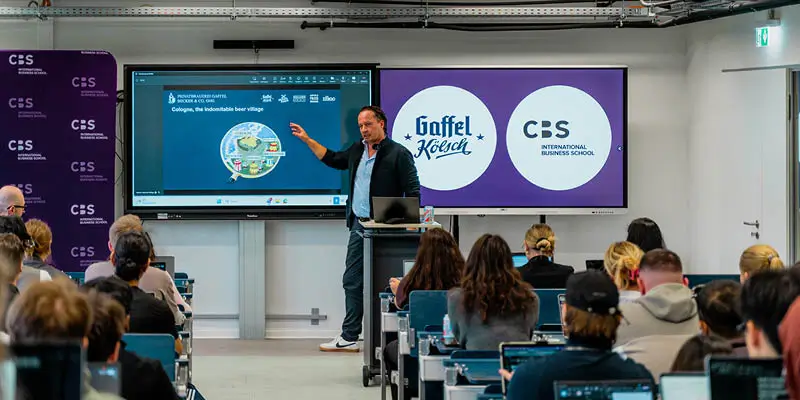
With Birgit Oßendorf-Will and Marc Sausen, CBS welcomed two experienced leaders from the STRÖER Group. Both brought extensive expertise in HR, communications and corporate development, offering students a realistic look behind the scenes of a dynamically growing corporation.
From Out-of-Home Advertising to a Digital Media Group
The lecture focused on the remarkable transformation of STRÖER. What once started as a traditional out-of-home advertising provider has evolved into a multifunctional media group with strong digital brands such as t-online.de, Statista and Asambeauty.
Today, STRÖER operates more than 300,000 advertising spaces, many of them digital and powered by sustainable energy sources. Innovative technologies such as LED brightness optimisation combine efficiency, sustainability and digital innovation.
Students gained insights into:
- Strategic growth processes
- Integration of newly acquired companies
- Central service structures within the group
- Technological innovations in the advertising market
Managing Growth: Structure Creates Freedom
One of STRÖER’s key success factors is the structured integration of new companies. Through centralised service structures, administrative processes are bundled, allowing individual ventures to focus on developing their core competencies.
This model demonstrates how strategic organisation and operational freedom can work together effectively.
Corporate Culture and the Use of AI
In addition to strategic development, corporate culture also played a central role.
One key statement from the lecture was:
Get things done, help each other, findways, stay connected
The speakers also highlighted how strongly artificial intelligence is already integrated into everyday business operations. From automated image processing to optimising recruiting processes, AI supports key areas of the organisation.
When it comes to recruiting, the speakers emphasised a clear principle: hiring based on attitude and mindset is crucial. Flexibility and willingness to learn are key qualities.
Direct Exchange Between Business and Academic Learning
Following the lecture, students had the opportunity to ask questions and gain deeper insights into decision-making processes at STRÖER.
This exchange demonstrated how business practice and academic education complement each other. Students were able to connect strategic concepts from their studies with real corporate examples.
Real-world business experience integrated into the curriculum
The guest lecture with STRÖER is a strong example of the practice-oriented learning concept at CBS.
In our business programmes, the connection to real-world business practice is systematically embedded through:
- Business Projects addressing real strategic and operational challenges from partner companies
- Regular guest lectures by executives and industry experts
- Conventions providing space for interdisciplinary learning and practice-oriented leadership experiences
- Case studies and simulation games addressing typical business challenges
- Mandatory internships for applying academic knowledge in a corporate context
- Dual study formats with continuous integration into company structures
- A network of more than 1,300 partner companies across various industries
This structured integration enables students not only to analyze economic challenges but also to develop well-founded decisions under real market conditions.
With initiatives like this, CBS reinforces its commitment to closely linking business and academia and preparing students specifically for leadership roles in a globalized and sustainability-oriented economy.
Conclusion: Understanding Transformation to Shape the Future
The guest lecture by STRÖER clearly demonstrated how strategic transformation, digital innovation and corporate culture interact.
For CBS students, the event was more than just an introduction to a media company. It provided a realistic understanding of how growth, technology and leadership work together in real business environments.
Key Takeaways
- Format: Guest lecture as part of the CBS Guest Lecture Series.
- Speakers: Birgit Oßendorf-Will (Group HR Director) and Marc Sausen (Senior Vice President Corporate Communications) from STRÖER.
- Main topics: Transformation from an out-of-home advertising provider to a digital media group, sustainability, AI and corporate culture.
- Company example: STRÖER operates more than 300,000 advertising spaces, many of them digital and powered by sustainable energy.
- Key message: Growth, innovation and integration succeed through clear structures, technology adoption and a strong corporate culture.
- Practical relevance: The guest lecture is part of the structured integration of corporate practice within the CBS business programmes.
Learning from Business Leaders with Real-World Experience
Guest lectures are a core component of the practice-oriented learning structure at CBS. Executives from corporations and medium-sized companies provide direct insights into strategic decision-making processes, organisational transformations and operational challenges.
With Birgit Oßendorf-Will and Marc Sausen, CBS welcomed two experienced leaders from the STRÖER Group. Both brought extensive expertise in HR, communications and corporate development, offering students a realistic look behind the scenes of a dynamically growing corporation.
From Out-of-Home Advertising to a Digital Media Group
The lecture focused on the remarkable transformation of STRÖER. What once started as a traditional out-of-home advertising provider has evolved into a multifunctional media group with strong digital brands such as t-online.de, Statista and Asambeauty.
Today, STRÖER operates more than 300,000 advertising spaces, many of them digital and powered by sustainable energy sources. Innovative technologies such as LED brightness optimisation combine efficiency, sustainability and digital innovation.
Students gained insights into:
- Strategic growth processes
- Integration of newly acquired companies
- Central service structures within the group
- Technological innovations in the advertising market
Managing Growth: Structure Creates Freedom
One of STRÖER’s key success factors is the structured integration of new companies. Through centralised service structures, administrative processes are bundled, allowing individual ventures to focus on developing their core competencies.
This model demonstrates how strategic organisation and operational freedom can work together effectively.
Corporate Culture and the Use of AI
In addition to strategic development, corporate culture also played a central role.
One key statement from the lecture was:
Get things done, help each other, findways, stay connected
The speakers also highlighted how strongly artificial intelligence is already integrated into everyday business operations. From automated image processing to optimising recruiting processes, AI supports key areas of the organisation.
When it comes to recruiting, the speakers emphasised a clear principle: hiring based on attitude and mindset is crucial. Flexibility and willingness to learn are key qualities.
Direct Exchange Between Business and Academic Learning
Following the lecture, students had the opportunity to ask questions and gain deeper insights into decision-making processes at STRÖER.
This exchange demonstrated how business practice and academic education complement each other. Students were able to connect strategic concepts from their studies with real corporate examples.
Real-world business experience integrated into the curriculum
The guest lecture with STRÖER is a strong example of the practice-oriented learning concept at CBS.
In our business programmes, the connection to real-world business practice is systematically embedded through:
- Business Projects addressing real strategic and operational challenges from partner companies
- Regular guest lectures by executives and industry experts
- Conventions providing space for interdisciplinary learning and practice-oriented leadership experiences
- Case studies and simulation games addressing typical business challenges
- Mandatory internships for applying academic knowledge in a corporate context
- Dual study formats with continuous integration into company structures
- A network of more than 1,300 partner companies across various industries
This structured integration enables students not only to analyze economic challenges but also to develop well-founded decisions under real market conditions.
With initiatives like this, CBS reinforces its commitment to closely linking business and academia and preparing students specifically for leadership roles in a globalized and sustainability-oriented economy.
Conclusion: Understanding Transformation to Shape the Future
The guest lecture by STRÖER clearly demonstrated how strategic transformation, digital innovation and corporate culture interact.
For CBS students, the event was more than just an introduction to a media company. It provided a realistic understanding of how growth, technology and leadership work together in real business environments.