How to Spot Fake News: What the 1835 Moon Hoax Still Teaches Us

25
.
08
.
2026
10
Min. reading time
Category |
Knowledge
Autor:

CBS University of Applied Sciences

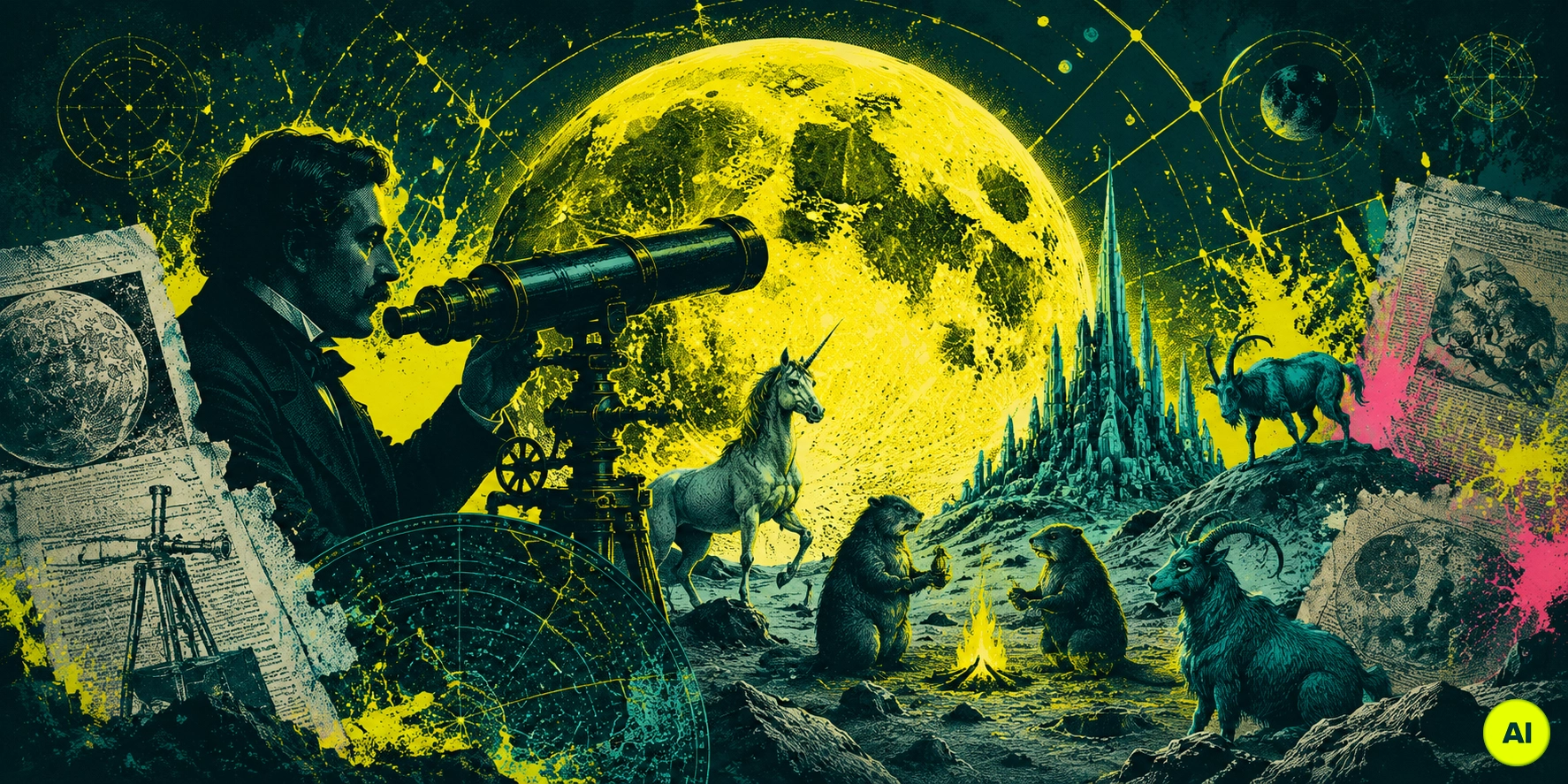
How fake news works: A man looks through a telescope at a moon inhabited by fantasy creatures – a reference to the Great Moon Hoax of 1835.

If you want to know how to spot fake news, the best place to start isn't your social media feed. It's a story from 1835.

That August, the New York newspaper The Sun published a six-part series claiming that astronomer John Herschel had discovered life on the moon: forests, oceans, bison, blue goats, even bat-winged humanoids living in temples of sapphire. None of it was true. Yet almost everyone believed it, including educated readers who should have known better.

The so-called Great Moon Hoax didn't work by breaking the rules of serious journalism. It worked by imitating them perfectly: a sober tone, a real scientist's name, precise technical detail. That's the same trick modern misinformation still relies on, whether it's a stranger's post shared thousands of times or an AI-generated headline that looks just credible enough to be real.

In this guide, you'll learn how the Moon Hoax worked, why education alone won't protect you from fake news, and exactly how to spot fake news before you share it.

Key Takeaways

  • Fake news, defined: deliberately false content dressed up as real news
  • The case: in 1835, The Sun claimed astronomer John Herschel had found life on the moon
  • The method: a sober tone, a real scientist's name, and precise technical detail, then the fantasy creatures
  • Education doesn't protect you automatically: a November 2024 meta-analysis of over 11,500 people found no link between education level and the ability to spot fake news
  • Familiarity is the strongest factor: the more often you've seen a claim, the more likely you are to believe it
  • The pattern: fake news borrows the format of credible sources to earn your trust
  • Growing concern: 62% of people worldwide now worry about fake news online, largely fueled by AI-generated content (Reuters Institute, 2026)
  • CBS link: Business Psychology at CBS teaches you how people actually process information and make decisions

1835: How a Newspaper Sent the World to the Moon

On August 25, 1835, The Sun published the first of six articles about supposed astronomical discoveries on the moon. It credited the British astronomer SirJohn Herschel, who really was running a telescope at the Cape ofGood Hope at the time, just not the one described, and with no idea the story existed.

The series was actually written by Sun reporter Richard Adams Locke, who claimed to be reprinting a special issue of the Edinburgh Journal of Science, a journal that had stopped publishing two years earlier. The rival New York Herald caught the flaw and published its own exposé on August 31, 1835, just six days after the first installment. It barely mattered. Most readers ignored the correction, and TheSun itself only admitted the story was fabricated on September16, 1835, three weeks later, without ever issuing a formal apology.

Locke described a brand-new telescope 24 feet across and weighing seven tons, plus exact detail about its location and observing conditions. Only after that foundation came the actual spectacle. The telescope had supposedly found:

•    Forests, oceans, and beaches

•    Bison and single-horned goats

•    Bipedal, tailless beavers: said to walk upright, live in huts, and use fire

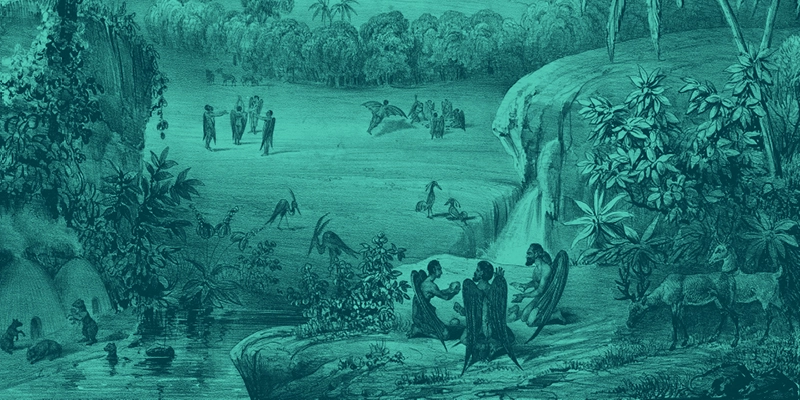
•    Bat-winged humanoids: called "Vespertilio-homo," supposedly builders of temples made from blue sapphire

Crowds gathered outside The Sun's offices during those days. One eyewitness later described people "clamoring to purchase copies," calling it a display of pure public credulity. Some claimed to have personally watched Herschel's telescope being loaded onto a ship bound for Africa, a scene that never actually happened.

The Sun was part of the"penny press," a wave of cheap, mass-market newspapers competing for readers through entertainment as much as information, the same commercial logic that would later fuel the sensationalized "yellow journalism" of the 1890s. According to some accounts the hoax boosted the paper's circulation, though historians note that boost has likely been exaggerated.

The series read like a scientific report, not a sensational story. That was exactly the point.
What Is Fake News?

Fake news is deliberately false or misleading content designed to look like real reporting. Unlike an honest mistake, it's spread on purpose, often to shape opinion, generate attention, or make money. What makes it effective isn't the lie itself. It's the packaging: fake news borrows the format of credible journalism to earn your trust.

The term itself is recent. The problem isn't. The Great Moon Hoax proves fake news worked long before the internet, using the exact same principle it still uses today: presenting itself as something it isn't.

Why Did the Moon Hoax Work? The Rise of Yellow Journalism

The Moon Hoax worked because it borrowed the authority of science. A sober tone, a real astronomer's name, a supposedly credible journal, and precise technical detail created an impression of legitimacy long before the exaggerations even started.

Communication scholars call this framing: deliberately presenting a topic through a specific lens that shapes how an audience interprets it. In his influential 1993 paper, political scientist Robert Entman described framing as selecting certain aspects of an issue and making them more prominent, so that a particular interpretation feels natural. With the Moon Hoax, the frame was serious science journalism, and inside that frame, even absurd claims felt plausible.

From a business psychology perspective, more than framing is at work here. Since we can't fact-check everything scientifically in daily life, we rely on mental shortcuts. The authority and source credibility heuristic makes us trust a claim more readily when it comes from an apparently competent source, like a real astronomer or a scientific journal. On top of that comes the illusory truth effect (first described by Hasher, Goldstein, and Toppino in 1977): the more often we hear a claim, the more plausible it feels, regardless of whether it's actually true. With the Moon Hoax, both mechanisms worked together: a source that looked credible, plus a consistent, repeated narrative.

“People don't check information the way scientists do in everyday life. We rely on mental shortcuts: if something sounds plausible, scientific, and familiar, we're quicker to believe it. These are exactly the mechanisms that make well-crafted disinformation so effective,” explains Prof. Dr. Bernd Wallraff, Professor of Business Psychology at CBS.

Writer Edgar Allan Poe, who witnessed the reaction firsthand, put it plainly in 1846: almost nobody doubted the story, and the few who did usually couldn't say why.

Why Doesn't Education Protect You From Fake News?

A high level of education is no reliable guarantee against fake news, at least according to one widely cited meta-analysis published in PNAS in November 2024. It covered 31 studies and more than 11,500 participants aged 18 to 88, all from the US, and found no significant link between education level and the ability to tell true headlines from false ones. The strongest predictor instead was familiarity: people were more likely to believe a claim simply because they'd seen it before. Because the underlying data is exclusively American, the finding doesn't automatically transfer one-to-one to other countries, though the general pattern lines up with what business psychology researchers see in other contexts too.

The study, led by the Max Planck Institute for Human Development, analyzed 256,337 individual decisions from participants in the US and was publicized more broadly in a press release the institute issued in February 2025. It also found an age paradox: older adults were actually better than younger adults at telling true headlines from false ones, but prior research shows they still share more misinformation in real life. Another twist: people with stronger analytical skills were more skeptical of obviously nonsensical claims, but more likely to accept misinformation that matched their own political views, a pattern researchers call motivated reasoning. Sharper thinking, in other words, doesn't automatically protect you from believing what you already want to believe.

That finding lines up with what happened at Yale in 1835. According to a contemporary account, students, professors, and even faculty in divinity and law waited eagerly for each new installment, full of confidence in the story. Education made people more skeptical of obvious nonsense elsewhere, apparently, but not of a well-packaged fake story closer to home.

Fake News vs. Misinformation vs. Disinformation: What's the Difference?

These terms get used interchangeably, but they don't mean quite the same thing. The key difference is intent.

Term Core Idea Example
Fake News Content deliberately designed to look like real news The 1835 Moon Hoax
Disinformation False information spread deliberately, usually with a strategic goal Targeted false claims during an election campaign
Misinformation False information passed on without any intent to deceive A shared fake-news post whose author was deceived themselves
Conspiracy Theories Claims about allegedly hidden, often powerful actors behind events The belief that the moon landing was staged

Conspiracy theories and fake news often overlap, but they're not identical. A piece of fake news can be a one-off, topic-specific claim. A conspiracy theory is usually a broader worldview that absorbs new facts into an existing pattern.

How widespread is the concern? 62% of people worldwide now say they worry about fake news online, according to the Reuters Institute's 2026 Digital News Report, up from the year before and driven largely by concerns about AI-generated content. In the US specifically, only 25% of people say they trust the news most of the time.

How Do You Spot Fake News? 5 Questions to Ask

You spot fake news most reliably by checking the source, not just the content. Ask who published the claim, whether it holds up against independent outlets, and whether the technical language actually means something or just sounds credible.

Here are five questions that would have exposed the Moon Hoax trick immediately, and still catch its modern version today:

  1. Who is the source? Check whether the named person, institution, or study actually exists, and whether they really said what's being claimed.
  2. Is there a second source? Real news usually shows up across several independent outlets, not just one.
  3. How old is this? Old images or stories often get recirculated out of context and passed off as current.
  4. Does the technical language actually check out? Precise-sounding details like measurements or study names aren't a substitute for verifying the source, even when they sound credible.
  5. Does it trigger a strong emotional reaction? Outrage, fear, or excitement lower your guard, and that's exactly what a lot of fake news is designed to do.

This checklist is a solid starting point. For a deeper walkthrough, including how to run a reverse image search, look out for a dedicated fact-checking guide coming soon to the CBS Blog.

{{call-to-action}}

From the Printing Press to the Algorithm: Why the Pattern Still Works Today

What's changed since 1835 isn't the principle. It's the speed. Back then, spreading a false story took a printing press and several days. Today, it takes an algorithm.

Younger audiences in particular now rely on social platforms for news. According to the Reuters Institute's 2026 Digital News Report, 52% of 18to 24-year-olds worldwide now name social media, video platforms, or AI chatbots as their main news source, well ahead of any other category. At the same time, global trust in news has dropped to 37%, the lowest level recorded since Reuters started tracking it in 2015.

The psychological mechanism behind that is the same one from 1835. What's new is mainly the scale. Artificial intelligence doesn't change why we believe credible-looking content, it changes how fast and in what volume that content gets made. What used to require a newsroom or a printing press can now be generated in seconds, varied endlessly, and aimed at individual audiences.

“AI hasn't changed the psychology behind fake news, ithas changed its scalability. What used to take significant effort to produceand distribute can now be generated, personalized, and distributed to millionsin seconds,”says Prof. Dr. Bernd Wallraff.

That combination makes the familiarity effect from the misinformation study even more powerful. The more often an algorithm shows you the same claim, the more familiar, and therefore more believable, it feels, regardless of whether it's actually true.

This is exactly the territory Business Psychology explores. The field studies how people actually process information, which mental shortcuts we rely on day to day, and why certain signals, like framing or borrowed authority, shape our decisions without us noticing. Business Psychology at CBS includes a dedicated module on media and consumer psychology, covering exactly this kind of automatic information processing and media influence. If you want a broader introduction first, CBS also has its own explainer on what Business Psychology actually covers.

If you want to go deeper intothe psychology behind persuasion, manipulation, and decision-making as a career path, CBS's Master's in Business Psychology offers a focused path forward, including part-time options for working professionals.

Conclusion

“The most dangerous fake news isn't the story that sounds absurd. It's the one that feels familiar and plausible,” is how Prof. Dr. Bernd Wallraff puts it.

The Great Moon Hoax of 1835 shows a pattern that still holds today: the most effective fake news usually isn't loud, it's well packaged. A calm tone, a veneer of authority, and a few convincing details are often all it takes to earn trust, whether the delivery mechanism is a telescope or an algorithm.

Education alone is no reliable protection from that. What helps is building the habit of actively checking sources instead of taking technical-sounding language at face value. That kind of thinking is exactly what a degree built around human decision-making trains you to do.

Curious whether Business Psychology is the right fit for you? Our student advisory team is happy to help you figure that out. And if fake news is a topic you want to keep exploring, more guides, including one on fact-checking and another on deepfakes, are coming soon to the CBS Blog.

If you want to know how to spot fake news, the best place to start isn't your social media feed. It's a story from 1835.

That August, the New York newspaper The Sun published a six-part series claiming that astronomer John Herschel had discovered life on the moon: forests, oceans, bison, blue goats, even bat-winged humanoids living in temples of sapphire. None of it was true. Yet almost everyone believed it, including educated readers who should have known better.

The so-called Great Moon Hoax didn't work by breaking the rules of serious journalism. It worked by imitating them perfectly: a sober tone, a real scientist's name, precise technical detail. That's the same trick modern misinformation still relies on, whether it's a stranger's post shared thousands of times or an AI-generated headline that looks just credible enough to be real.

In this guide, you'll learn how the Moon Hoax worked, why education alone won't protect you from fake news, and exactly how to spot fake news before you share it.

Key Takeaways

  • Fake news, defined: deliberately false content dressed up as real news
  • The case: in 1835, The Sun claimed astronomer John Herschel had found life on the moon
  • The method: a sober tone, a real scientist's name, and precise technical detail, then the fantasy creatures
  • Education doesn't protect you automatically: a November 2024 meta-analysis of over 11,500 people found no link between education level and the ability to spot fake news
  • Familiarity is the strongest factor: the more often you've seen a claim, the more likely you are to believe it
  • The pattern: fake news borrows the format of credible sources to earn your trust
  • Growing concern: 62% of people worldwide now worry about fake news online, largely fueled by AI-generated content (Reuters Institute, 2026)
  • CBS link: Business Psychology at CBS teaches you how people actually process information and make decisions

1835: How a Newspaper Sent the World to the Moon

On August 25, 1835, The Sun published the first of six articles about supposed astronomical discoveries on the moon. It credited the British astronomer SirJohn Herschel, who really was running a telescope at the Cape ofGood Hope at the time, just not the one described, and with no idea the story existed.

The series was actually written by Sun reporter Richard Adams Locke, who claimed to be reprinting a special issue of the Edinburgh Journal of Science, a journal that had stopped publishing two years earlier. The rival New York Herald caught the flaw and published its own exposé on August 31, 1835, just six days after the first installment. It barely mattered. Most readers ignored the correction, and TheSun itself only admitted the story was fabricated on September16, 1835, three weeks later, without ever issuing a formal apology.

Locke described a brand-new telescope 24 feet across and weighing seven tons, plus exact detail about its location and observing conditions. Only after that foundation came the actual spectacle. The telescope had supposedly found:

•    Forests, oceans, and beaches

•    Bison and single-horned goats

•    Bipedal, tailless beavers: said to walk upright, live in huts, and use fire

•    Bat-winged humanoids: called "Vespertilio-homo," supposedly builders of temples made from blue sapphire

Crowds gathered outside The Sun's offices during those days. One eyewitness later described people "clamoring to purchase copies," calling it a display of pure public credulity. Some claimed to have personally watched Herschel's telescope being loaded onto a ship bound for Africa, a scene that never actually happened.

The Sun was part of the"penny press," a wave of cheap, mass-market newspapers competing for readers through entertainment as much as information, the same commercial logic that would later fuel the sensationalized "yellow journalism" of the 1890s. According to some accounts the hoax boosted the paper's circulation, though historians note that boost has likely been exaggerated.

The series read like a scientific report, not a sensational story. That was exactly the point.

What Is Fake News?

Fake news is deliberately false or misleading content designed to look like real reporting. Unlike an honest mistake, it's spread on purpose, often to shape opinion, generate attention, or make money. What makes it effective isn't the lie itself. It's the packaging: fake news borrows the format of credible journalism to earn your trust.

The term itself is recent. The problem isn't. The Great Moon Hoax proves fake news worked long before the internet, using the exact same principle it still uses today: presenting itself as something it isn't.

Why Did the Moon Hoax Work? The Rise of Yellow Journalism

The Moon Hoax worked because it borrowed the authority of science. A sober tone, a real astronomer's name, a supposedly credible journal, and precise technical detail created an impression of legitimacy long before the exaggerations even started.

Communication scholars call this framing: deliberately presenting a topic through a specific lens that shapes how an audience interprets it. In his influential 1993 paper, political scientist Robert Entman described framing as selecting certain aspects of an issue and making them more prominent, so that a particular interpretation feels natural. With the Moon Hoax, the frame was serious science journalism, and inside that frame, even absurd claims felt plausible.

From a business psychology perspective, more than framing is at work here. Since we can't fact-check everything scientifically in daily life, we rely on mental shortcuts. The authority and source credibility heuristic makes us trust a claim more readily when it comes from an apparently competent source, like a real astronomer or a scientific journal. On top of that comes the illusory truth effect (first described by Hasher, Goldstein, and Toppino in 1977): the more often we hear a claim, the more plausible it feels, regardless of whether it's actually true. With the Moon Hoax, both mechanisms worked together: a source that looked credible, plus a consistent, repeated narrative.

“People don't check information the way scientists do in everyday life. We rely on mental shortcuts: if something sounds plausible, scientific, and familiar, we're quicker to believe it. These are exactly the mechanisms that make well-crafted disinformation so effective,” explains Prof. Dr. Bernd Wallraff, Professor of Business Psychology at CBS.

Writer Edgar Allan Poe, who witnessed the reaction firsthand, put it plainly in 1846: almost nobody doubted the story, and the few who did usually couldn't say why.

Why Doesn't Education Protect You From Fake News?

A high level of education is no reliable guarantee against fake news, at least according to one widely cited meta-analysis published in PNAS in November 2024. It covered 31 studies and more than 11,500 participants aged 18 to 88, all from the US, and found no significant link between education level and the ability to tell true headlines from false ones. The strongest predictor instead was familiarity: people were more likely to believe a claim simply because they'd seen it before. Because the underlying data is exclusively American, the finding doesn't automatically transfer one-to-one to other countries, though the general pattern lines up with what business psychology researchers see in other contexts too.

The study, led by the Max Planck Institute for Human Development, analyzed 256,337 individual decisions from participants in the US and was publicized more broadly in a press release the institute issued in February 2025. It also found an age paradox: older adults were actually better than younger adults at telling true headlines from false ones, but prior research shows they still share more misinformation in real life. Another twist: people with stronger analytical skills were more skeptical of obviously nonsensical claims, but more likely to accept misinformation that matched their own political views, a pattern researchers call motivated reasoning. Sharper thinking, in other words, doesn't automatically protect you from believing what you already want to believe.

That finding lines up with what happened at Yale in 1835. According to a contemporary account, students, professors, and even faculty in divinity and law waited eagerly for each new installment, full of confidence in the story. Education made people more skeptical of obvious nonsense elsewhere, apparently, but not of a well-packaged fake story closer to home.

Fake News vs. Misinformation vs. Disinformation: What's the Difference?

These terms get used interchangeably, but they don't mean quite the same thing. The key difference is intent.

Term Core Idea Example
Fake News Content deliberately designed to look like real news The 1835 Moon Hoax
Disinformation False information spread deliberately, usually with a strategic goal Targeted false claims during an election campaign
Misinformation False information passed on without any intent to deceive A shared fake-news post whose author was deceived themselves
Conspiracy Theories Claims about allegedly hidden, often powerful actors behind events The belief that the moon landing was staged

Conspiracy theories and fake news often overlap, but they're not identical. A piece of fake news can be a one-off, topic-specific claim. A conspiracy theory is usually a broader worldview that absorbs new facts into an existing pattern.

How widespread is the concern? 62% of people worldwide now say they worry about fake news online, according to the Reuters Institute's 2026 Digital News Report, up from the year before and driven largely by concerns about AI-generated content. In the US specifically, only 25% of people say they trust the news most of the time.

How Do You Spot Fake News? 5 Questions to Ask

You spot fake news most reliably by checking the source, not just the content. Ask who published the claim, whether it holds up against independent outlets, and whether the technical language actually means something or just sounds credible.

Here are five questions that would have exposed the Moon Hoax trick immediately, and still catch its modern version today:

  1. Who is the source? Check whether the named person, institution, or study actually exists, and whether they really said what's being claimed.
  2. Is there a second source? Real news usually shows up across several independent outlets, not just one.
  3. How old is this? Old images or stories often get recirculated out of context and passed off as current.
  4. Does the technical language actually check out? Precise-sounding details like measurements or study names aren't a substitute for verifying the source, even when they sound credible.
  5. Does it trigger a strong emotional reaction? Outrage, fear, or excitement lower your guard, and that's exactly what a lot of fake news is designed to do.

This checklist is a solid starting point. For a deeper walkthrough, including how to run a reverse image search, look out for a dedicated fact-checking guide coming soon to the CBS Blog.

{{call-to-action}}

From the Printing Press to the Algorithm: Why the Pattern Still Works Today

What's changed since 1835 isn't the principle. It's the speed. Back then, spreading a false story took a printing press and several days. Today, it takes an algorithm.

Younger audiences in particular now rely on social platforms for news. According to the Reuters Institute's 2026 Digital News Report, 52% of 18to 24-year-olds worldwide now name social media, video platforms, or AI chatbots as their main news source, well ahead of any other category. At the same time, global trust in news has dropped to 37%, the lowest level recorded since Reuters started tracking it in 2015.

The psychological mechanism behind that is the same one from 1835. What's new is mainly the scale. Artificial intelligence doesn't change why we believe credible-looking content, it changes how fast and in what volume that content gets made. What used to require a newsroom or a printing press can now be generated in seconds, varied endlessly, and aimed at individual audiences.

“AI hasn't changed the psychology behind fake news, ithas changed its scalability. What used to take significant effort to produceand distribute can now be generated, personalized, and distributed to millionsin seconds,”says Prof. Dr. Bernd Wallraff.

That combination makes the familiarity effect from the misinformation study even more powerful. The more often an algorithm shows you the same claim, the more familiar, and therefore more believable, it feels, regardless of whether it's actually true.

This is exactly the territory Business Psychology explores. The field studies how people actually process information, which mental shortcuts we rely on day to day, and why certain signals, like framing or borrowed authority, shape our decisions without us noticing. Business Psychology at CBS includes a dedicated module on media and consumer psychology, covering exactly this kind of automatic information processing and media influence. If you want a broader introduction first, CBS also has its own explainer on what Business Psychology actually covers.

If you want to go deeper intothe psychology behind persuasion, manipulation, and decision-making as a career path, CBS's Master's in Business Psychology offers a focused path forward, including part-time options for working professionals.

Conclusion

“The most dangerous fake news isn't the story that sounds absurd. It's the one that feels familiar and plausible,” is how Prof. Dr. Bernd Wallraff puts it.

The Great Moon Hoax of 1835 shows a pattern that still holds today: the most effective fake news usually isn't loud, it's well packaged. A calm tone, a veneer of authority, and a few convincing details are often all it takes to earn trust, whether the delivery mechanism is a telescope or an algorithm.

Education alone is no reliable protection from that. What helps is building the habit of actively checking sources instead of taking technical-sounding language at face value. That kind of thinking is exactly what a degree built around human decision-making trains you to do.

Curious whether Business Psychology is the right fit for you? Our student advisory team is happy to help you figure that out. And if fake news is a topic you want to keep exploring, more guides, including one on fact-checking and another on deepfakes, are coming soon to the CBS Blog.

Find out what suits you

Are you interested in learning more about degree programs that explore how people actually process information?

Request your information package today with no obligation!

Understand how people really make decisions

In the Business Psychology program at CBS, you will learn how perception, framing, and trust influence our decisions—with a focus on practical application and no restricted admission (NC).

Discover the Business Psychology degree program now!

FAQS: Frequently Asked Questions

What is the difference between fake news and disinformation?

Why doesn't education automatically protect against fake news?

What was the Great Moon Hoax of 1835?

How can I spot fake news in everyday life?

What is the difference between fake news and conspiracy theories?

Arrange a consultation
Send a WhatsApp
Send an email
Call now!
Events