English‑Taught Universities in Germany
Your 2026 Guide to Studying in English

Study in Germany in English at a glance
- Hundreds of options: Germany has more than 420 universities, and over 200 of them offer at least one programme taught entirely in English
- Free tuition at public universities: Most public institutions charge no tuition fees; you only pay a semester contribution of around €200–€300 covering administrative costs and public transport.
- Wide range of fields: Business, Engineering, natural sciences, economics, social sciences and mathematics have the largest number of English‑language programmes, while medicine, arts and sports are less commonly offered in English.
- Admission requirements: To enrol you’ll need a recognised high‑school diploma or bachelor’s degree, proof of English proficiency (e.g., TOEFL 80+ or IELTS 6.5+) and supporting documents such as a motivation letter, CV and passport.
- Learning German helps: You can study entirely in English, but learning some German improves your daily life, increases your choice of programmes and opens up local job opportunities.
- CBS advantage: CBS offers state‑recognised bachelor’s, master’s and MBA programmes in English with strong corporate links, real‑world projects and flexible study options. Our individual career coaching and global network help you step confidently into leadership roles across industries. For students who do not yet meet the admission requirements for studying in Germany, Prep4University, CBS’s English-taught preparatory courses, provides targeted preparation for the Feststellungsprüfung (FSP). CBS is one of the very few universities of applied sciences in Germany to offer this preparatory pathway entirely in English.
Germany has become a top destination for students seeking high-quality education in English. Renowned for academic excellence, innovation, and an outstanding quality of life, the country offers ideal conditions for international students. The best part? You can earn a degree without speaking German. With over 200 universities offering English-taught programmes, students can explore everything from business and engineering to social sciences and digital transformation—fully in English. This guide breaks down how to find the right programme, what to expect during the application process and why choosing CBS University of Applied Sciences will set you up for success.
Understanding English‑Taught Programmes in Germany
Germany’s higher‑education system consists of research‑intensive universities (Universitäten) and practice‑oriented universities of applied sciences (Fachhochschulen). Out of over 420 higher‑education institutions, more than 200 offer at least one programme taught completely in English. These programmes are designed for international students and cover bachelor’s, master’s and doctoral levels.
Not every international school certificate is directly recognised in Germany, but this is not a barrier, it’s a starting point. At Prep4University, CBS’s private, state-accredited Studienkolleg, students prepare intensively for the Feststellungsprüfung (FSP) and obtain their university entrance qualification within just one year, creating a clear pathway into English-taught degree programmes.
If you are still finishing high school or want to understand how German schooling prepares students for university, read our overview of the school education system in Germany to learn how secondary education pathways lead into higher education.
Public vs. private universities
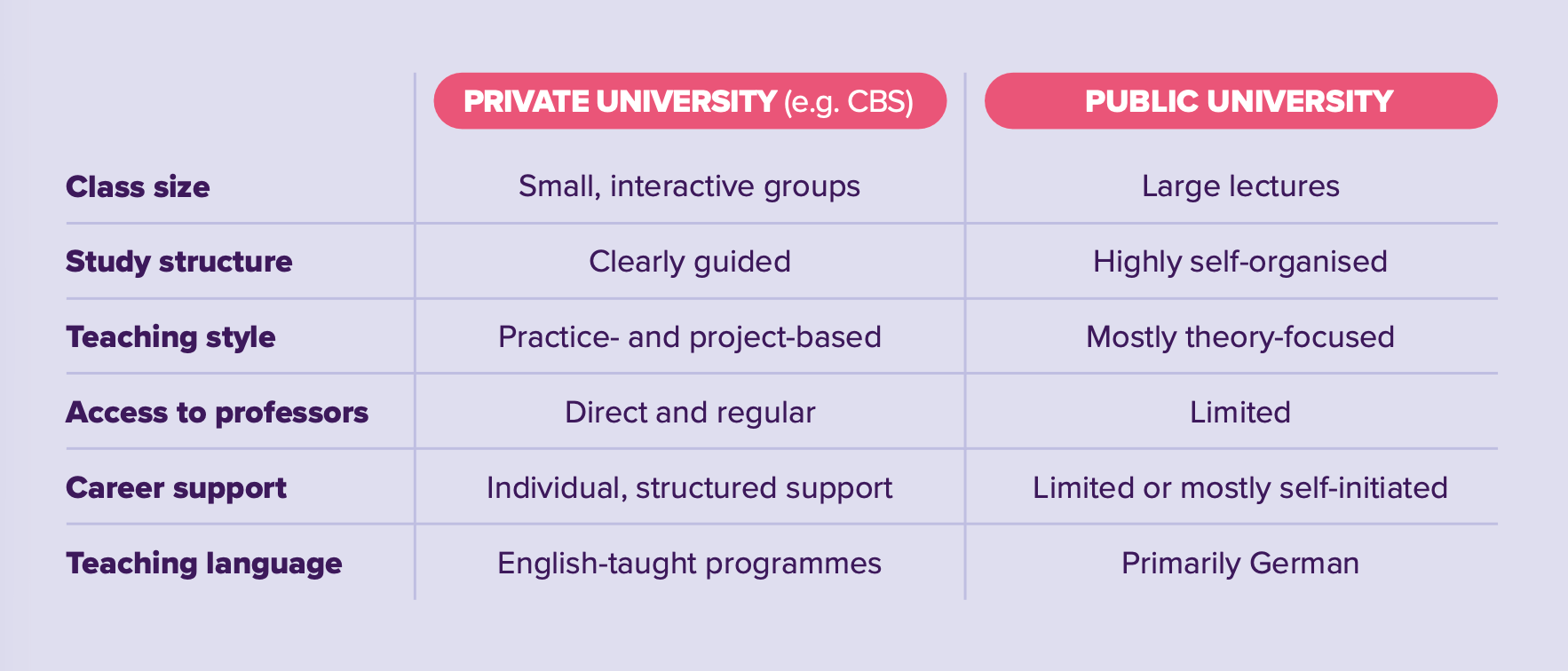
Both public and private universities in Germany offer English-taught study programmes, but the overall study experience can differ significantly. Public universities are known for their academic reputation, research excellence, and low or no tuition fees, making them an attractive option for many international students. However, English-taught programmes at public institutions are mostly offered at master’s level, while English bachelor’s programmes are less common. In addition, large class sizes are typical, which can limit individual interaction with lecturers.
Private universities usually offer a wider range of English-taught programmes at both bachelor’s and master’s levels. They place a strong emphasis on practice-oriented, career-focused education and maintain close connections to industry. Thanks to smaller class sizes, students benefit from personalised support, direct contact with professors, and structured support services. While tuition fees are higher, private universities often provide scholarships, financial aid, and flexible payment options. Admission processes may also focus on motivation, career goals, and personal fit, not grades alone.
Admission Requirements and Language Skills to Study in English in German Universities
Every university has its own admission rules, but there are common elements you should prepare for:
- Academic qualifications: For bachelor’s degrees you need a recognised high‑school diploma or equivalent. Master’s and MBA applicants must hold a relevant bachelor’s degree.
- Language proficiency: Since you’ll study in English, universities require proof of English skills through tests such as TOEFL (usually 80 points or higher) or IELTS (6.5or above). Some programmes accept PTE Academic or Cambridge certificates. If the programme combines English and German, you may also need to demonstrate basic German (often A2 or B1 level).
- Supporting documents: Expect to submit a motivation letter explaining why you chose the programme, an up‑to‑date CV, academic transcripts and a copy of your passport. Certain universities may request reference letters or portfolio work for design and media programmes.
- Entrance assessments: A few programmes, especially business or engineering master’s degrees, include aptitude tests or interviews. Check deadlines carefully, as applications for the winter semester typically close by mid‑July and those for the summer semester by mid‑January.















Best English‑Taught Universities in Germany
While many institutions provide English‑language courses, some stand out due to their reputation, breadth of programmes and support services. Here’s a list of some of the best institutions where you can pursue your studies in English.
1. CBS University of Applied Sciences
Private, state-recognised and accredited university with multiple campuses across Germany. CBS offers practice-oriented bachelor’s, master’s and MBA programmes in business and management, as well as English-taught preparatory programmes (Studienkolleg Prep4University), designed to reflect current industry trends and real-world requirements.
The English-taught programmes are based at the Cologne campus, which serves as the international hub of CBS. Students gain hands-on experience through real projects with more than 1,300 partner companies and benefit from individual career coaching throughout their studies.
2. Ludwig‑Maximilians‑Universität München (LMU)
One of Germany’s largest universities with around 51,000 students. Offers numerous English‑taught master’s programmes across arts, sciences and business. As a public university there are no tuition fees.
3. Technical University of Munich (TUM)
Member of the TU9 consortium; recognised as a “University of Excellence”. Provides over 60 English‑taught degree programmes and attracts about 20 % international students.
4. Heidelberg University
Germany’s oldest university; globally ranked. Runs a variety of English‑taught master’s programmes in natural sciences, humanities and medicine.
5. Free University of Berlin
Designated “University of Excellence”. Offers English‑language master’s degrees in social sciences, natural sciences and business; tuition free for public programmes.
6. Humboldt University of Berlin
Founded in 1806 and home to multiple Nobel laureates. Provides English‑taught programmes in law, social sciences and natural sciences.
How much does it cost to study in Germany in English?
Studying in Germany in English is often affordable, especially compared to other popular study destinations. However, costs depend largely on whether you choose a public or private university, as well as the type of programme and location.
Public Universities
Most public universities in Germany do not charge regular tuition fees, even for international students. Instead, students pay a semester contribution, usually between €200 and €300, which covers administrative costs and often includes a public transport ticket.
There are a few important exceptions to keep in mind. Professional and executive programmes, such as MBAs or highly specialised master’s degrees, may charge tuition fees even at public institutions, sometimes exceeding €10,000 per year. In addition, the state of Baden-Württemberg requires non-EU students to pay €1,500 per semester on top of the standard semester contribution.
Private Universities
Private universities in Germany typically charge higher tuition fees, but they also offer a different study experience. Fees usually range from €5,000 to €7,000 per semester, depending on the institution and programme. In return, students often benefit from smaller class sizes, personalised mentoring, modern facilities, and strong links to industry. Many private universities also provide scholarships, early-bird discounts, and flexible payment plans to make studying more accessible.
Funding and Part-Time Work
To help finance your studies, students can apply for scholarships and funding programmes, including support from organisations such as DAAD, private foundations, and Erasmus+ grants. International students from non-EU countries are generally allowed to work up to 140 full days or 280 half-days per year, providing an additional source of income. Many universities also award merit-based scholarships to high-performing students.
Living Costs
Beyond tuition, it’s important to budget for everyday living expenses such as rent, food, health insurance, and transport. The cost of living in Germany varies by city, with larger metropolitan areas typically being more expensive than smaller cities. Planning ahead and understanding these costs early on helps ensure a smooth start to your studies and avoids unexpected financial pressure.
Application Process: How to apply for an English-taught programme
Applying for an English-taught degree in Germany follows a structured approach, but application processes can vary depending on the university and programme. Starting early and following a clear step-by-step plan will help you stay organised, meet deadlines, and avoid unnecessary stress throughout the application process.
1. Choose the right programme: Begin by defining your field of interest and aligning it with your career goals. Popular English-taught fields in Germany include business, finance, marketing, logistics, entrepreneurship, human resources, technology management, and psychology.
Once you’ve shortlisted programmes, visit each university’s website to review curriculum details, entry requirements, internship opportunities, and application procedures.
2. Prepare your documents early: Gather all required application documents well in advance. These typically include:
- School or university transcripts and certificates
- Proof of English proficiency (e.g. IELTS or TOEFL, if required)
- Passport
- Motivation letter or personal statement.
If your documents are not in English or German, make sure you provide official translations.3.
3. Submit your application: Most applications are submitted online, either through Uni-Assist or directly via the university’s own application portal. Deadlines usually fall around: Mid-July or Mid-January. After completing the application form, upload your documents and pay any required processing fee. Some universities may request certified hard copies after provisional admission.
4. Complete interviews or aptitude tests (if required): Certain programmes, especially in business or engineering, may include online interviews or require standardised test results such as GMAT or GRE scores. Be prepared to explain your motivation, academic background, and career ambitions.
5. Receive admission and enroll: Once you receive an offer, you’ll need to:
- Submit certified copies of your documents
- Provide proof of health insurance
- Pay the semester contribution or tuition fee: After enrolment, the university issues an enrolment certificate, which is essential for your student visa application.
6. Arrange visa, accommodation, and arrival: International students from outside the EU must apply for a German student visa, which requires proof of health insurance and a blocked account to cover living expenses. Accommodation should be arranged as early as possible, especially in large cities where housing is competitive.
At CBS University of Applied Sciences, the International Office supports international students throughout this process. From guidance on visa requirements and health insurance to advice on accommodation and arrival in Germany, the team helps ensure a smooth transition so you can focus on starting your studies with confidence.
7. Use available support services: Support services can make a big difference to your study experience. Look for universities that offer language courses, career counselling, housing guidance, and international student networks.
At CBS University of Applied Sciences, international students benefit from German language courses, personalised career coaching through the Career Service, support with internships and job applications, and guidance during arrival and settling in. A strong international community and student initiatives help you build connections from day one.
The CBS Advantage – Study Business in English with a Purpose
CBS University of Applied Sciences is a state‑recognised, practice‑oriented business school with campuses across Germany. Our programmes are designed to equip you for leadership roles in a digitally transforming world. Here’s what sets us apart:

- Real projects, real impact: From the first semester you work on real business challenges with our network of more than 1,300 partner companies. Whether it’s developing a marketing strategy for a local start‑up or analysing supply chains for a global corporation, you learn by doing.
- Leading experts and mentors: Your lecturers come from management, consulting and entrepreneurship and share insights that go far beyond theory. Guest speakers from industry leaders provide inspiration and networking opportunities.
- Future‑proof skills: Our NXT GEN and NEW ERA curricula combines business fundamentals with digital fluency, teamwork and problem‑solving. You learn to use AI tools, manage innovation and drive sustainable change – skills that employers demand.
- Global perspective: Study alongside peers from over 75 nations, participate in international projects and choose from partner universities worldwide for a semester abroad. You build intercultural competence and a global network.
- Flexible formats: Choose from full-time or part-time bachelor’s, master’s and MBA programmes, as well as preparatory courses. You can focus on marketing, finance, logistics, entrepreneurship, human resources, technology management, sales or business psychology.
- Individual career coaching: Our Career Service supports you with CV workshops, interview training and internship placement. You leave CBS ready to assume leadership positions across industries – from tech start‑ups to multinational corporations.
Get your free Brochure
Are you interested in an English-taught bachelor’s or master’s programme in Germany and ready to launch your international career?
Then request our free brochure now. Inside, you’ll find everything you need to know about our English-taught programmes – from corriculum and career opportunities to admission requirements.

FAQs about studying in English in Germany – Everything you need to know
Are you interested in studying in English in Germany and still have questions? Here you’ll find the most important answers about English-taught programmes at CBS University of Applied Sciences. From benefits and admission requirements to choosing the right programme, discover everything you need to know to start your international academic journey with confidence.
Are there English‑speaking universities in Germany?
Do I need to speak German to study in Germany?
What are the admission requirements for English‑taught programmes in Germany?
How can I apply for an English‑taught programme in Germany?
What is student life like in Germany for international students?
Is Germany a good place to start my career after studying in English?
Where can I study in English at CBS?
The Cologne campus of CBS University of Applied Sciences offers both bachelor’s and master’s programmes taught entirely in English in a full-time and part-time study formats. The programmes combine academically sound content with a strong practical focus, preparing you specifically for the demands of today’s job market.
At the CBS Cologne campus, you can complete your entire bachelor’s or master’s degree in English. In addition, preparatory courses (Prep4University) for international students do not yet meet the admission requirements for studying in Germany. Our programmes are designed to merge academic depth with hands-on learning and prepare you for the requirements of the international labour market.
With around 1,600 students from more than 75 nations, you will study in an international and interdisciplinary learning environment. Thanks to CBS’s central location in Cologne, you benefit from close proximity to companies in the region, as well as numerous opportunities for internships and career entry.
Learn more about the Cologne campus:

Any Questions?
Do you have questions about our Bachelor’s or Master’s degree programmes? Simply book your personal consultation appointment now – either online or on-site! Our team offers individual support without obligation to help you find the right degree programme.