Format: Guest lecture as part of the CBS Guest Lecture Series
Speaker: Heinrich Philipp Becker
Position: Managing Partner
Company: Privatbrauerei Gaffel Becker & Co. OHG
Industry: Brewing / Beverage Industry
Topic focus: Growth in a changing market, consumption occasions instead of demographics alone, entrepreneurial ownership
Practical example: Competing for time: why streaming, gaming and social media compete with going out and, with it, with beer
Practice link: The lecture shows how real-world business perspectives are systematically integrated into CBS International Business School study programmes.
Growth against the odds: Insights from Cologne's Brewing Industry
Real-world insights from industry are a central element of the study concept at CBS International Business School. In the CBS Guest Lecture Series , executives and experts regularly share insights into current developments in business and markets.
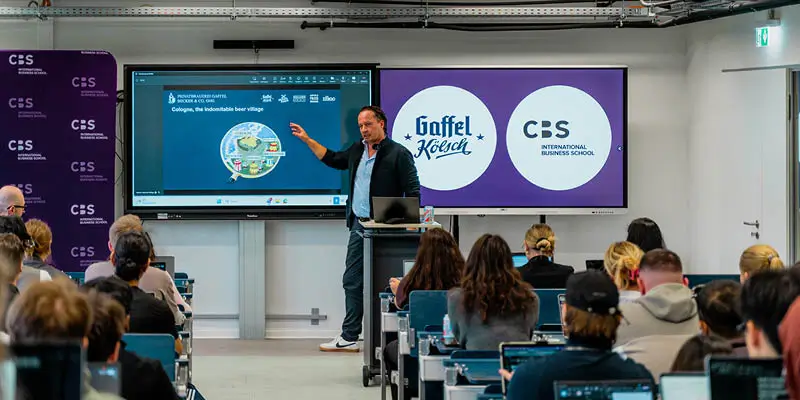
As part of this series, CBS International Business School welcomed Heinrich Philipp Becker, Managing Partner at Gaffel, to the Cologne campus. The host was Prof. Dr. Ulrich Anders. In his energetic presentation, Becker demonstrated how companies can continue to grow successfully even in a challenging market environment.
The private brewery Gaffel was founded in Cologne in 1908 and is now a fourth-generation family business. The lecture was aimed at students of the CBS NXTGEN program. In these business-oriented bachelor's degree programs, guest lectures are firmly anchored in the curriculum every two weeks.
In his energetic presentation, Becker demonstrated how companies can continue to grow successfully even in a challenging market environment.
Competing for Time: Why Breweries Don't Just Compete with Breweries
The German brewing industry is under pressure. According to the Federal Statistical Office (Destatis), beer sales fell by 6.0% in 2025 to roughly 7.8 billion litres. At the same time, the number of breweries dropped to 1,415.
Becker was candid about what this means for the industry: rising competitive pressure, insolvencies and beer prices that have not kept pace with rising costs. As a result, established business models are coming under increasing strain.
One particularly interesting perspective was the impact of digital consumption. Streaming, gaming and social media increasingly compete with going out and socialising. So the competition is not only between breweries or beverage brands. It is a competition for people's time and their consumption occasions.
Why is demographics not enough for market segmentation?
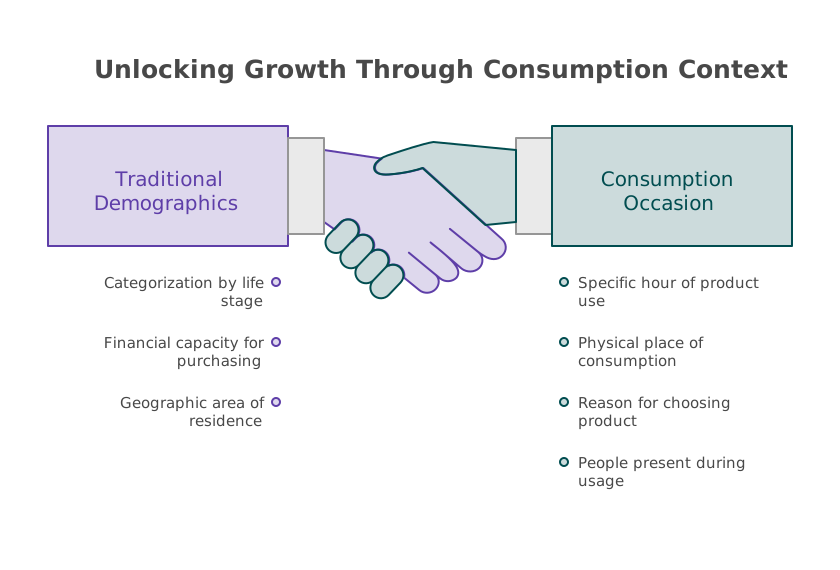
Traditional segmentation by age, income or location shows who buys a product. It does not reveal the moments in which that product is actually consumed. Companies that understand when, where, why and with whom people use a product can spot growth opportunities that a purely demographic view overlooks.
Becker summed it up in one line: “Don't just look at demographics, look at the day.” In practice, this translates into four guiding questions:
When is the product consumed?
Where does the consumption take place?
Why do people choose this product?
Who are they sharing it with?
For students, this is a valuable shift in perspective. Marketing does not start with a target group profile, but with the consumption occasion in customers' everyday lives.
How Can Companies Grow Against the Trend?
When overall demand declines, growth does not come from doing more of the same. It takes entrepreneurial thinking, cost discipline, full transparency about your own numbers and the courage to build new products and markets rather than simply competing for existing demand.
Despite the challenging environment, Becker's central message was optimistic and entrepreneurial. He presented the principles that, in his view, make the difference:
Think outside the box: challenge established ways of doing business
Pursue cost leadership and maintain operational discipline
Know your numbers: good dashboard control creates the transparency needed for the right decisions
Build products and build markets rather than simply competing for existing demand
Diversify the product portfolio and develop new business opportunities
Grow internationally and look beyond the domestic market
Build emotional relevance around products and brands
Stay close to customers and understand changing consumption occasions
Have the ambition to become a market leader
Gaffel itself shows what international growth can look like in practice. Beyond its home city, the brewery is represented in major German cities as well as in the USA, Brazil, Asia and popular holiday destinations. According to the brewery, Gaffel is also the most popular Kölsch in the restaurant trade, with a market share of almost 30 percent.
{{call-to-action}}
People make the difference: entrepreneurial ownership
Perhaps the most powerful takeaway concerned the people within a company. Strategy, products and numbers matter. But ultimately, it is people who take ownership who make the difference.
Becker highlighted three attitudes that are key to sustainable success:
Take ownership
Think like an entrepreneur
Having the courage to seize new opportunities
For future leaders, the message is clear. A shrinking market does not necessarily mean shrinking opportunities. With entrepreneurial thinking, customer proximity and cost discipline, established companies can continue to grow and reinvent themselves.
Real-World Business Experience Embedded in the Curriculum
The guest lecture by Gaffel exemplifies the concept of practice-oriented learning at CBS International Business School.
Across our business programmes, the integration of real-world business practice is systematically embedded through:
Business Projects with real strategic and operationalchallenges from partner companies
Regular Guest Lectures from executives and industryexperts
Conventions providing space forinterdisciplinary learning and hands-on leadership experience
Case Studies and Simulation Games to tackle typical business problems
Mandatory internships to apply academic knowledge in acorporate context
Dual study formats with continuous integration intobusiness structures
A network of more than 1,300partner companies across industries
This structured integration enables students not only to analyse business challenges analytically, but to develop well-founded decisions under real market conditions.
Anyone who chooses to study at CBS International Business School not only receives a scientifically grounded education but also gains the opportunity to build confidence in a professional environment at an early stage, within a team, in a company, and in front of decision-makers.
With events like this, CBS International Business School underlines its commitment to systematically embedding practice-oriented learning in its programmes and preparing students for leadership and expert roles in the digital economy.
Conclusion: Growth begins with entrepreneurial courage
Heinrich Philipp Becker's lecture demonstrated the opportunities that exist even in a changing market. Companies that understand consumption occasions, keep a close eye on their numbers and boldly develop new products and markets can achieve targeted growth and actively shape their future.
The event offered students valuable insights into entrepreneurial growth strategies and a realistic picture of working in the brewing and beverage industry.
A heartfelt thank you goes to Heinrich Philipp Becker and Gaffel for sharing these insights, and to Prof. Dr. Ulrich Anders for hosting another inspiring edition of the CBS Guest Lecture Series.
Key Takeaways
Format: Guest lecture as part of the CBS Guest Lecture Series
Speaker: Heinrich Philipp Becker
Position: Managing Partner
Company: Privatbrauerei Gaffel Becker & Co. OHG
Industry: Brewing / Beverage Industry
Topic focus: Growth in a changing market, consumption occasions instead of demographics alone, entrepreneurial ownership
Practical example: Competing for time: why streaming, gaming and social media compete with going out and, with it, with beer
Practice link: The lecture shows how real-world business perspectives are systematically integrated into CBS International Business School study programmes.
Growth against the odds: Insights from Cologne's Brewing Industry
Real-world insights from industry are a central element of the study concept at CBS International Business School. In the CBS Guest Lecture Series , executives and experts regularly share insights into current developments in business and markets.
As part of this series, CBS International Business School welcomed Heinrich Philipp Becker, Managing Partner at Gaffel, to the Cologne campus. The host was Prof. Dr. Ulrich Anders. In his energetic presentation, Becker demonstrated how companies can continue to grow successfully even in a challenging market environment.
The private brewery Gaffel was founded in Cologne in 1908 and is now a fourth-generation family business. The lecture was aimed at students of the CBS NXTGEN program. In these business-oriented bachelor's degree programs, guest lectures are firmly anchored in the curriculum every two weeks.
In his energetic presentation, Becker demonstrated how companies can continue to grow successfully even in a challenging market environment.
Competing for Time: Why Breweries Don't Just Compete with Breweries
The German brewing industry is under pressure. According to the Federal Statistical Office (Destatis), beer sales fell by 6.0% in 2025 to roughly 7.8 billion litres. At the same time, the number of breweries dropped to 1,415.
Becker was candid about what this means for the industry: rising competitive pressure, insolvencies and beer prices that have not kept pace with rising costs. As a result, established business models are coming under increasing strain.
One particularly interesting perspective was the impact of digital consumption. Streaming, gaming and social media increasingly compete with going out and socialising. So the competition is not only between breweries or beverage brands. It is a competition for people's time and their consumption occasions.
Why is demographics not enough for market segmentation?
Traditional segmentation by age, income or location shows who buys a product. It does not reveal the moments in which that product is actually consumed. Companies that understand when, where, why and with whom people use a product can spot growth opportunities that a purely demographic view overlooks.
Becker summed it up in one line: “Don't just look at demographics, look at the day.” In practice, this translates into four guiding questions:
When is the product consumed?
Where does the consumption take place?
Why do people choose this product?
Who are they sharing it with?
For students, this is a valuable shift in perspective. Marketing does not start with a target group profile, but with the consumption occasion in customers' everyday lives.
How Can Companies Grow Against the Trend?
When overall demand declines, growth does not come from doing more of the same. It takes entrepreneurial thinking, cost discipline, full transparency about your own numbers and the courage to build new products and markets rather than simply competing for existing demand.
Despite the challenging environment, Becker's central message was optimistic and entrepreneurial. He presented the principles that, in his view, make the difference:
Think outside the box: challenge established ways of doing business
Pursue cost leadership and maintain operational discipline
Know your numbers: good dashboard control creates the transparency needed for the right decisions
Build products and build markets rather than simply competing for existing demand
Diversify the product portfolio and develop new business opportunities
Grow internationally and look beyond the domestic market
Build emotional relevance around products and brands
Stay close to customers and understand changing consumption occasions
Have the ambition to become a market leader
Gaffel itself shows what international growth can look like in practice. Beyond its home city, the brewery is represented in major German cities as well as in the USA, Brazil, Asia and popular holiday destinations. According to the brewery, Gaffel is also the most popular Kölsch in the restaurant trade, with a market share of almost 30 percent.
{{call-to-action}}
People make the difference: entrepreneurial ownership
Perhaps the most powerful takeaway concerned the people within a company. Strategy, products and numbers matter. But ultimately, it is people who take ownership who make the difference.
Becker highlighted three attitudes that are key to sustainable success:
Take ownership
Think like an entrepreneur
Having the courage to seize new opportunities
For future leaders, the message is clear. A shrinking market does not necessarily mean shrinking opportunities. With entrepreneurial thinking, customer proximity and cost discipline, established companies can continue to grow and reinvent themselves.
Real-World Business Experience Embedded in the Curriculum
The guest lecture by Gaffel exemplifies the concept of practice-oriented learning at CBS International Business School.
Across our business programmes, the integration of real-world business practice is systematically embedded through:
Business Projects with real strategic and operationalchallenges from partner companies
Regular Guest Lectures from executives and industryexperts
Conventions providing space forinterdisciplinary learning and hands-on leadership experience
Case Studies and Simulation Games to tackle typical business problems
Mandatory internships to apply academic knowledge in acorporate context
Dual study formats with continuous integration intobusiness structures
A network of more than 1,300partner companies across industries
This structured integration enables students not only to analyse business challenges analytically, but to develop well-founded decisions under real market conditions.
Anyone who chooses to study at CBS International Business School not only receives a scientifically grounded education but also gains the opportunity to build confidence in a professional environment at an early stage, within a team, in a company, and in front of decision-makers.
With events like this, CBS International Business School underlines its commitment to systematically embedding practice-oriented learning in its programmes and preparing students for leadership and expert roles in the digital economy.
Conclusion: Growth begins with entrepreneurial courage
Heinrich Philipp Becker's lecture demonstrated the opportunities that exist even in a changing market. Companies that understand consumption occasions, keep a close eye on their numbers and boldly develop new products and markets can achieve targeted growth and actively shape their future.
The event offered students valuable insights into entrepreneurial growth strategies and a realistic picture of working in the brewing and beverage industry.
A heartfelt thank you goes to Heinrich Philipp Becker and Gaffel for sharing these insights, and to Prof. Dr. Ulrich Anders for hosting another inspiring edition of the CBS Guest Lecture Series.
Discover the NXT GEN Bachelor
Regular guest lectures, real business challenges and a curriculum built for tomorrow's economy: that's the NXT GEN bachelor's programme at CBS International Business School.