Guest Lecture by crossconsulting: Consulting, Banking and the Future of Finance

20
.
07
.
2026
0
Min. reading time
Category |
Guest Lectures
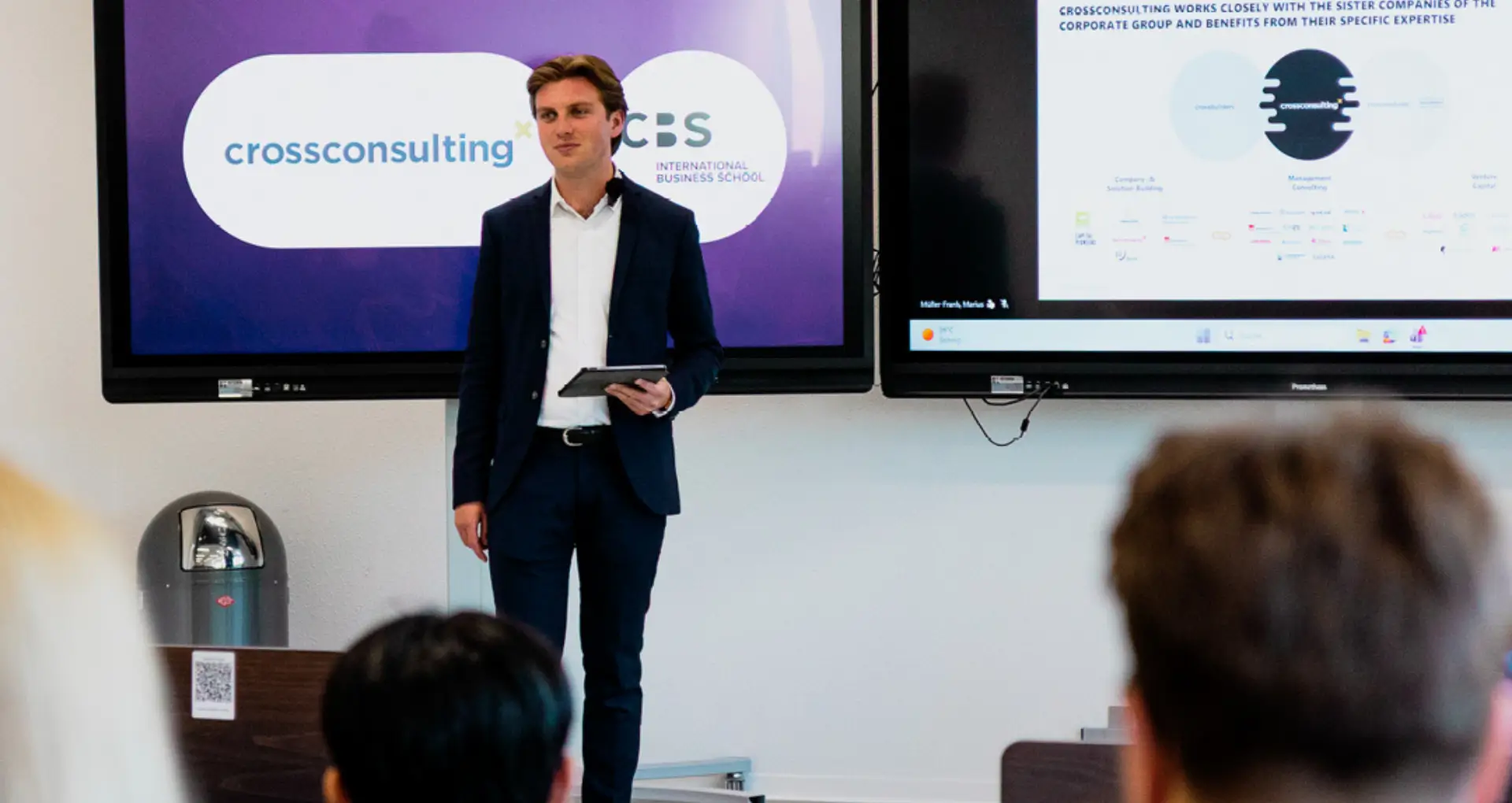
Consultant Paul Maurice Lehmann from crossconsulting is giving a guest lecture infront of CBS students.

Key Takeaways

  • Format: Guest lecture as part of the CBS Guest Lecture Series
  • Speakers: Marius Müller Frank and Paul Maurice Lehman
  • Position: Manager (Marius Müller Frank) and Consultant (Paul Maurice Lehman)
  • Company: crossconsulting GmbH, Cologne
  • Industry: Banking, Insurance, Financial Services, Software and Venture Capital
  • Topic focus: Consulting business model and scaling, regulatory demand in finance, software projects, capital markets, AI in consulting
  • Practical example: Full project lifecycle in financial consulting: from strategy through software development to testing
  • Practice link: The lecture shows how real-world business perspectives are systematically integrated into CBS study programmes.

Where Consulting Meets Banking, Software and AI

Real-world insights from industry are a central element of the study concept at CBS. Through the CBS Guest Lecture Series, executives and experts regularly share insights into current developments in business and markets.

As part of this series, Prof. Dr. Ulrich Anders welcomed Marius Müller Frank, Manager, and Paul Maurice Lehman, Consultant, from crossconsulting to campus in Cologne. The session explored how consulting works in the financial sector and what it takes to succeed in this people-driven industry.

crossconsulting is a Cologne-based management consultancy specialising in banking, insurance, financial services, related software and venture capital. The firm doesn't just design strategies for its clients but also implements them operationally.

Understanding the Consulting Business: Fees, Scaling and the Human Factor

Marius and Paul Maurice opened by explaining how management consultancies generate revenue. Fees come from deploying people who exchange their expertise for time and effort. This sounds straight forward, but it has one far-reaching implication: scaling a consultancy is significantly harder than scaling other types of business.

A software company can sell its product thousands of times without proportional additional cost. Consulting doesn't work that way. Every new project requires qualified consultants. Growth means hiring, training and maintaining quality all at once.

This human dependency makes consulting a People Business in the truest sense. For students, this was a key insight: in consulting, it's not just technical knowledge that counts, but the ability to work in teams, build trust and support clients over the long term.

Regulation as a Growth Driver: Why the Financial Sector Needs Consultants

A central theme of the lecture was the role of regulation. The banking sector operates under strict rules that are regularly updated or tightened. New legislation, EU directives or financial supervisory requirements create continuous need for action.

For management consultants, this represents a stable source of demand. Banks and insurers must remain compliant but often lack the internal capacity to implement every requirement independently. This is where consultants come in, bringing both regulatory knowledge and project experience.

Marius and Paul Maurice made this point clearly: anyone who wants to advise in the financial sector must understand the regulatory landscape. This is not a niche topic; it is often the starting point for entire project cycles.

From Roadmap to Testing: Software Projects in Financial Consulting

Another key focus of the lecture was the typical lifecycle of a consulting project at crossconsulting. Projects begin with an overarching strategy, followed by a preparatory study. From there comes technical implementation, where various stakeholders must be coordinated throughout the process.

The speakers covered software projects in particular depth. These run through several phases: from roadmap through business concept and solution design to development and testing. The testing phase is especially critical, Marius emphasised: faulty software in the financial sector can cause significant reputational damage.

Stakeholder management also featured prominently. Every project involves competing interests. Those who understand the needs of all parties involved and can negotiate workable compromises have a decisive advantage.

Capital Markets, AI and Career Advice from the Field

Marius and Paul Maurice also shared specialist knowledge on capital markets. Students gained insights into trading systems, order flows and the workings of modern trading platforms. This knowledge is particularly relevant for consulting projects in investment banking and asset management.

The speakers also addressed the impact of AI on the consulting industry. Artificial intelligence is changing how data is analysed, reports are generated and processes are automated. At the same time,human judgement remains the decisive element, especially in heavily regulated industries like finance.

Their advice to students was clear: build genuine expertise in a specific area. Those who combine subject-matter depth with methodological strength will have the best long-term prospects in consulting.

{{call-to-action}}

crossconsulting: Specialist Advisory for the Financial Sector

crossconsulting is headquartered in Cologne's Rheinauhafen district and is part of the sven c. sixt management holding. In addition to its base in Cologne, the firm has offices in Frankfurt am Main and Basel.

Its advisory offering spans strategy and transformation projects in the banking and insurance sectors, alongside related software projects and venture capital. With around 40 permanent consultants and up to 200 situational specialists, crossconsulting combines entrepreneurial agility with deep subject-matter expertise.

Real-World Business Experience Embedded in the Curriculum

The guest lecture by crossconsulting exemplifies the concept of practice-oriented learning at CBS.

Across our business programmes, the integration of real-world business practice is systematically embedded through:

  1. Business Projects with real strategic and operational challenges from partner companies
  2. Regular Guest Lectures from executives and industry experts
  3. Conventions providing space forinter disciplinary learning and hands-on leadership experience
  4. Case Studies and Simulation Games to tackle typical business problems
  5. Mandatory internships to apply academic knowledge in a corporate context
  6. Dual study formats with continuous integration into business structures
  7. A network of more than 1,300partner companies across industries

This structured integration enables students not only to analyse business challenges analytically, but to develop well-founded decisions under real market conditions.

Anyone who chooses to study at CBS not only receives a scientifically grounded education but also gains the opportunity to build confidence in a professional environment at an early stage, within a team, in a company, and in front of decision-makers.

With events like this, CBS underlines its commitment to systematically embedding practice-oriented learning in its programmes and preparing students for leadership and expert roles in the digital economy.

Conclusion: Consulting as a Profession Between Expertise and People Skills

The guest lecture by crossconsulting demonstrated just how multifaceted and demanding consulting in the financial sector can be. From fee structures and regulatory requirements to complex software projects, the session covered a broad spectrum of professional reality.

The event offered students valuable insights into the intersection of consulting, banking and technology, and a realistic picture of working at a specialist management consultancy.

Key Takeaways

  • Format: Guest lecture as part of the CBS Guest Lecture Series
  • Speakers: Marius Müller Frank and Paul Maurice Lehman
  • Position: Manager (Marius Müller Frank) and Consultant (Paul Maurice Lehman)
  • Company: crossconsulting GmbH, Cologne
  • Industry: Banking, Insurance, Financial Services, Software and Venture Capital
  • Topic focus: Consulting business model and scaling, regulatory demand in finance, software projects, capital markets, AI in consulting
  • Practical example: Full project lifecycle in financial consulting: from strategy through software development to testing
  • Practice link: The lecture shows how real-world business perspectives are systematically integrated into CBS study programmes.

Where Consulting Meets Banking, Software and AI

Real-world insights from industry are a central element of the study concept at CBS. Through the CBS Guest Lecture Series, executives and experts regularly share insights into current developments in business and markets.

As part of this series, Prof. Dr. Ulrich Anders welcomed Marius Müller Frank, Manager, and Paul Maurice Lehman, Consultant, from crossconsulting to campus in Cologne. The session explored how consulting works in the financial sector and what it takes to succeed in this people-driven industry.

crossconsulting is a Cologne-based management consultancy specialising in banking, insurance, financial services, related software and venture capital. The firm doesn't just design strategies for its clients but also implements them operationally.

Understanding the Consulting Business: Fees, Scaling and the Human Factor

Marius and Paul Maurice opened by explaining how management consultancies generate revenue. Fees come from deploying people who exchange their expertise for time and effort. This sounds straight forward, but it has one far-reaching implication: scaling a consultancy is significantly harder than scaling other types of business.

A software company can sell its product thousands of times without proportional additional cost. Consulting doesn't work that way. Every new project requires qualified consultants. Growth means hiring, training and maintaining quality all at once.

This human dependency makes consulting a People Business in the truest sense. For students, this was a key insight: in consulting, it's not just technical knowledge that counts, but the ability to work in teams, build trust and support clients over the long term.

Regulation as a Growth Driver: Why the Financial Sector Needs Consultants

A central theme of the lecture was the role of regulation. The banking sector operates under strict rules that are regularly updated or tightened. New legislation, EU directives or financial supervisory requirements create continuous need for action.

For management consultants, this represents a stable source of demand. Banks and insurers must remain compliant but often lack the internal capacity to implement every requirement independently. This is where consultants come in, bringing both regulatory knowledge and project experience.

Marius and Paul Maurice made this point clearly: anyone who wants to advise in the financial sector must understand the regulatory landscape. This is not a niche topic; it is often the starting point for entire project cycles.

From Roadmap to Testing: Software Projects in Financial Consulting

Another key focus of the lecture was the typical lifecycle of a consulting project at crossconsulting. Projects begin with an overarching strategy, followed by a preparatory study. From there comes technical implementation, where various stakeholders must be coordinated throughout the process.

The speakers covered software projects in particular depth. These run through several phases: from roadmap through business concept and solution design to development and testing. The testing phase is especially critical, Marius emphasised: faulty software in the financial sector can cause significant reputational damage.

Stakeholder management also featured prominently. Every project involves competing interests. Those who understand the needs of all parties involved and can negotiate workable compromises have a decisive advantage.

Capital Markets, AI and Career Advice from the Field

Marius and Paul Maurice also shared specialist knowledge on capital markets. Students gained insights into trading systems, order flows and the workings of modern trading platforms. This knowledge is particularly relevant for consulting projects in investment banking and asset management.

The speakers also addressed the impact of AI on the consulting industry. Artificial intelligence is changing how data is analysed, reports are generated and processes are automated. At the same time,human judgement remains the decisive element, especially in heavily regulated industries like finance.

Their advice to students was clear: build genuine expertise in a specific area. Those who combine subject-matter depth with methodological strength will have the best long-term prospects in consulting.

{{call-to-action}}

crossconsulting: Specialist Advisory for the Financial Sector

crossconsulting is headquartered in Cologne's Rheinauhafen district and is part of the sven c. sixt management holding. In addition to its base in Cologne, the firm has offices in Frankfurt am Main and Basel.

Its advisory offering spans strategy and transformation projects in the banking and insurance sectors, alongside related software projects and venture capital. With around 40 permanent consultants and up to 200 situational specialists, crossconsulting combines entrepreneurial agility with deep subject-matter expertise.

Real-World Business Experience Embedded in the Curriculum

The guest lecture by crossconsulting exemplifies the concept of practice-oriented learning at CBS.

Across our business programmes, the integration of real-world business practice is systematically embedded through:

  1. Business Projects with real strategic and operational challenges from partner companies
  2. Regular Guest Lectures from executives and industry experts
  3. Conventions providing space forinter disciplinary learning and hands-on leadership experience
  4. Case Studies and Simulation Games to tackle typical business problems
  5. Mandatory internships to apply academic knowledge in a corporate context
  6. Dual study formats with continuous integration into business structures
  7. A network of more than 1,300partner companies across industries

This structured integration enables students not only to analyse business challenges analytically, but to develop well-founded decisions under real market conditions.

Anyone who chooses to study at CBS not only receives a scientifically grounded education but also gains the opportunity to build confidence in a professional environment at an early stage, within a team, in a company, and in front of decision-makers.

With events like this, CBS underlines its commitment to systematically embedding practice-oriented learning in its programmes and preparing students for leadership and expert roles in the digital economy.

Conclusion: Consulting as a Profession Between Expertise and People Skills

The guest lecture by crossconsulting demonstrated just how multifaceted and demanding consulting in the financial sector can be. From fee structures and regulatory requirements to complex software projects, the session covered a broad spectrum of professional reality.

The event offered students valuable insights into the intersection of consulting, banking and technology, and a realistic picture of working at a specialist management consultancy.

Real-world experience that makes the difference during your studies

Gain hands-on experience through real company projects during your Bachelor's or Master's degree and develop the skills that truly advance your career.

Start learning through real-world practice

Find your practice-oriented degree

Do you want more than just theory and want to work on real projects with companies? Discover CBS english-taught practice-oriented bachelor’s and master's programmes and find the programme that matches your interests and career goals.

Discover our practice-oriented english-taught programmes

Arrange a consultation
Send a WhatsApp
Send an email.
Call now!
Events