Rage bait marketing is everywhere right now, even if you have not heard the term yet. Picture an ad campaign that makes millions of people furious, and that is exactly the point. Welcome to rage bait marketing: brands deliberately provoke anger or outrage because negative reactions often travel further online than positive ones. Sounds risky? It is. And yet more and more companies are betting on it anyway. The Oxford University Press named "rage bait" its 2025 Word of the Year, noting the term's usage had tripled over the past twelve months. Campaigns from brands like American Eagle and Burger King show just how much attention deliberate provocation can generate, sometimes for weeks on end. But the math does not always work out. Rage bait marketing can turn into a PR disaster just as fast as it turns into a headline. And as you will see, not every wave of online outrage is even real. In this article, you will learn how the tactic works, which brands have used it, and why it stays a risky game no matter how well it performs in the short term.
What Is Rage Bait Marketing?
Rage bait marketing means campaigns or content designed on purpose to spark anger, outrage, or heated debate in order to win attention and reach. The term combines "rage" and "bait", and at its core it chases the same goal as marketing in general: getting attention for a brand, just through unusually aggressive means.
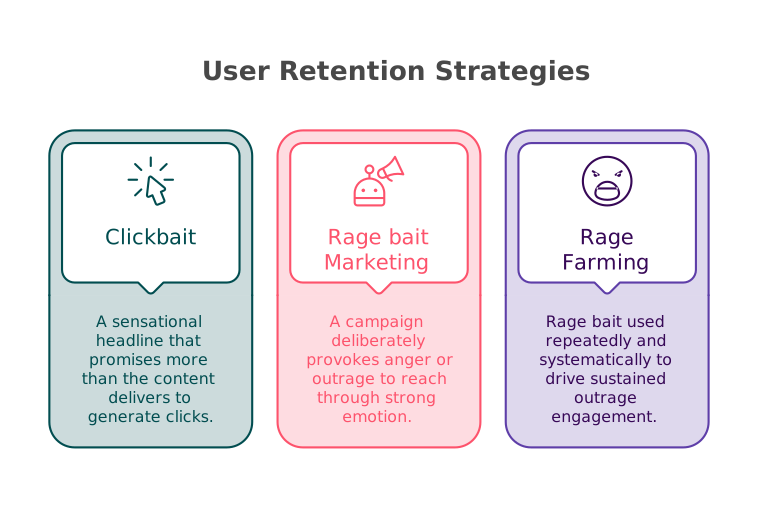
The difference from clickbait matters, so you do not mix the terms up:
Rage bait used repeatedly and systematically to drive sustained outrage engagement.
The idea itself is not new. The term has been documented since the 2010s, but it only went mainstream through platforms like TikTok, Instagram, and LinkedIn, where algorithms reward every reaction, angry or not.
Why Does Outrage Work So Well Online?
Outrage spreads faster online than agreement, because algorithms reward every interaction and people react more strongly to negative emotions than positive ones. A post that racks up comments, shares, or likes automatically gets shown to more people, regardless of whether the reaction is angry or warm.
There is a psychological pattern behind this: negativity bias. People respond more strongly to negative stimuli than positive ones, and they would rather correct someone than agree with them. An angry comment gets typed faster than a thoughtful compliment. Rage bait marketing exploits exactly that.
.svg)
On LinkedIn, though, this logic has started to hit limits. The platform adjusted its algorithm in 2025 and 2026 specifically to downrank outrage-driven content. Posts are now scored more on how long people actually read them, not purely on how many comments a provocation generates. For brands, that means what still works on TikTok increasingly backfires on LinkedIn.
On TikTok, the math looks different again. Content there gets pushed to people who do not yet follow the account, which forces creators to grab attention within seconds. Typical rage bait patterns here include deliberately wrong pronunciations, broken expectations, or statements that look unfair at first glance. What drives viral reach on TikTok can flop fast on a business platform like LinkedIn, because different rules apply there.
Is Rage Bait Marketing the Same as Outrage Marketing?
Not quite, though the two get used interchangeably a lot. Outrage marketing is the older, broader term: a deliberate attempt to build brand awareness by triggering shock, anger, or indignation, and it predates today's "rage bait" slang by well over a decade. It has been used for everything from provocative product ads to political messaging.
Rage bait marketing is best understood as outrage marketing's social-media-native offspring: same underlying mechanism, but built specifically around how platform algorithms reward engagement, and often more focused on a single viral moment than on a sustained brand stance. If you are researching the topic, both terms are worth knowing, since marketing coverage uses them somewhat interchangeably depending on the era and the platform being discussed.
Well-Known Examples of Rage Bait Marketing
Rage bait marketing is far from a fringe tactic at this point. Several of the world's best-known brands made headlines with provocative campaigns in 2025. You have probably scrolled past at least one of them yourself. A look at the actual cases shows how different the triggers were:
- American Eagle (2025): The campaign "Sydney Sweeney Has Great Jeans" played on the pun between "jeans" and "genes." Critics accused the brand of echoing eugenics messaging, and the debate dominated headlines for nearly half a year.
- e.l.f. Cosmetics (2025): The beauty brand cast comedian Matt Rife, previously criticized for jokes about domestic violence, in a campaign. After the backlash, the company said it had "missed the mark" and pulled the campaign.
- Skims (2025): A roughly $48 face-shaping band was promoted by Kim Kardashian on Instagram as a way to get a slimmer chin, sparking a debate about beauty standards.
- Burger King UK (2021): To mark International Women's Day, the brand opened a social post with the line "women belong in the kitchen". The actual message, a scholarship program for women in the restaurant industry, got lost in the outrage over the opening line.
- Pepsi (2017): An early precursor: an ad starring Kendall Jenner tried to smooth over real social tension with a can of soda and was widely criticized for it.
Marketing observers explain the surge with a simple calculation: brands have realized the algorithm can be gamed for free attention, even if that attention does not last.
These campaigns sit close to influencer marketing: both disciplines depend on generating attention across social networks, just with a completely different emotional sign attached.
Was It Even Intentional?
This is where it gets interesting, because not every one of these cases was actually planned. Industry observers classify many widely discussed campaigns as unintentional. The theory: brands try to tap into cultural moments, misjudge the context, and stumble into a backlash rather than provoking one on purpose.
A clear case of a misstep rather than a strategy is Swatch. In 2025, the Swiss watchmaker ran an ad showing an Asian model pulling his eyelids into a "slanted eye" gesture widely condemned as racist. Criticism erupted within hours on Chinese social media. Swatch pulled the campaign worldwide and issued a public apology, and the stock dropped the following day. No marketing team plans something like that on purpose.
The distinction matters for you as a reader: part of what gets labeled rage bait marketing today is really just a cultural blind spot, not a calculated move.
Was That Backlash Even Real?
Not every wave of online outrage is actually human. A recent example comes from the US restaurant chain Cracker Barrel: after unveiling a new logo in summer 2025, the brand appeared to face a massive wave of criticism online. But according to data from the analytics firm PeakMetrics, roughly 44.5 percent of posts about the topic on X were likely bots within the first 24 hours. Among calls for a boycott, the bot share was close to half.
The company reacted anyway: the new logo was pulled, and renovated locations were told to bring back the old design. In the end, the real damage was financial, not necessarily rooted in genuine public anger.
This points to a new challenge for brands: AI makes it easier than ever to manufacture fake outrage waves that real users then pick up and amplify. If you want to judge a rage bait situation correctly, it pays to look twice before reacting.
Tip: When a wave of outrage looks suspicious, check how old the loudest accounts are and how similar their wording sounds. Both are common signs of coordinated or automated activity.
The Risks: Why Rage Bait Often Backfires
Short term, rage bait marketing works almost every time: reach and attention spike immediately. Long term, plenty of brands pay a steep price for it.
One analysis found that traffic rises briefly after a rage bait moment, but customer loyalty to the brand can drop by nearly 40 percent within three months. People do not read provoked reactions as genuine interest, they often read them as a reason to walk away from a brand. Think about your own behavior: a brand that annoyed you is not one you typically buy from more often afterward.
Trust takes a hit too. Social and influencer marketing consultant Lia Haberman warns that a short-term bump in attention rarely offsets the long-term damage to brand equity. For brands that rely on brand management and long-term customer relationships, that is a critical point: reputation built over years can be damaged by a single misjudged campaign.
If you want to work professionally on building and protecting brands, CBS's English-taught Bachelor's in Marketing Management gives you exactly the tools to spot these risks early and manage them smarter.
{{call-to-action}}
Is There an Alternative to Rage Bait?
Yes, and some brands prove it convincingly. Not every successful campaign needs provocation. Gap went viral in 2025 with a joyful denim campaign alongside the girl group KATSEYE, built entirely on choreography, good energy, and authenticity rather than controversy.
Doritos also shows that humor can work without real anger: a playful campaign teasing a supposed switch from triangular to square chips earned laughs instead of backlash. The difference lies in tone and intent: making people smile, rather than genuinely hurting them, can still get you noticed, without the risk.
The real skill lies in taking a clear stance without deliberately hurting or manipulating anyone. For your own content, that means: personality and edge, yes; calculated provocation, no.
What Marketing Professionals Can Learn From Rage Bait
Rage bait marketing makes one thing very clear: emotion is an extremely powerful lever in marketing, but using it well takes real skill. If you understand why anger drives so much reach online, you can apply that insight without resorting to provocation yourself, for example through honest, opinionated content that takes a genuine stance.
That is exactly what you learn in a marketing-focused degree: how campaigns actually work, which psychological mechanisms drive them, and how to build reach without putting your own brand at risk. That applies to classic marketing just as much as to content creators, who produce new content daily and constantly have to weigh attention against responsibility.
Three questions are worth asking before any campaign goes live:
- Would the message still work without the provocative edge?
- Does the short-term reach justify the potential loss of trust?
- Can the outrage actually be controlled, or could the campaign spiral completely out of hand?
Answering these honestly leads to better decisions than any short-term reach strategy ever will.
If this intersection of creativity, psychology, and strategy interests you, CBS's Bachelor's in Marketing Management offers exactly this kind of practical grounding, taught entirely in English.
Conclusion
Rage bait marketing can generate enormous reach in the short term, no question. But the examples from Burger King to Cracker Barrel show something else too: brands that lean on provocation are gambling with their audience's trust, and sometimes with outrage that was never even real to begin with. Long-term winners tend to choose a genuine stance over manufactured anger, as Gap and Doritos both show.
That kind of judgment, knowing the impact, the risk, and the responsibility behind a campaign, is something you can learn. Whether you are just starting out in marketing or looking to sharpen your skills, what matters in the end is building campaigns that get noticed and still fit your brand.
Want to buildcampaigns that get noticed, without the risk?
CBS's English-taught Bachelor's in MarketingManagement gives you the practical skills for modern, responsible marketing.
Already working andready for the next step?
CBS's English-taught Master's in DigitalMarketing builds on your experience and takes your career to the next level.