Study format: English-language, part-time Master’s programme at CBS.
Company: DN Group AG
Business project: 27 students developed real solutions in eight teams for DN Group AG in Frankfurt.
Focus topics: Impact investing, water credit markets and sustainable go-to-market strategies.
Academic supervision: Guided by Professor Dr Hanno Martens throughout the semester.
Board presentation: Results were presented directly to the board of DN Group AG.
Practical relevance: The project demonstrates the close integration of academic theory and corporate practice within the Master’s programme.
Practice-Oriented Learning: The Business Project in the Part-Time Master’s Programme
A core component of the part-time Master’s programmes at CBS is the Business Project. Conducted during the course of study, it combines academic methodology with real-world business challenges.
In the current project, students from the English-taught part-time Master’s programs in Strategic Management (M.Sc.)worked together in eight interdisciplinary teams. The project was led by Professor Dr. Hanno Martens, who provided academic guidance and coordinated collaboration with the corporate partner.
From September to December, the teams worked intensively on strategic and entrepreneurial challenges defined by DN Group AG in Frankfurt. The objective was to develop innovative yet implementable concepts that address current global trends such as sustainability, impact investing, and corporate responsibility.
analyze real company data
develop strategic recommendations
present their results to decision-makers
strategically expand their professional network
The Assignments: Impact Investing, Water Credit, and Market Entry Strategies
The project topics were developed in close coordination with DN Group AG. Students worked directly on strategically relevant issues for the company.
Impact Investing
Several teams analyzed the potential of impact investing strategies. The goal was to design investment models that generate both financial returns and measurable social or environmental impact.
The students:
examined market trends and regulatory frameworks
developed evaluation models for impact metrics
formulated concrete strategic recommendations for DN Group AG
Innovative Business Models for Save the Water GmbH
Another focus area was the development of new business models for Save the Water GmbH. The emphasis was on sustainable water solutions and their economic scalability.
The teams developed:
Business Model Canvas concepts
financing and partnership strategies
scenarios for international expansion
Water Credit Market
Within the Water Credit Market topic, students analyzed market structures and financing mechanisms in the field of water-related climate instruments.
The objective was to sharpen DN Group AG’s positioning in this growing market and identify strategic options for market entry or expansion.
Go-to-Market Strategies for Soapeya
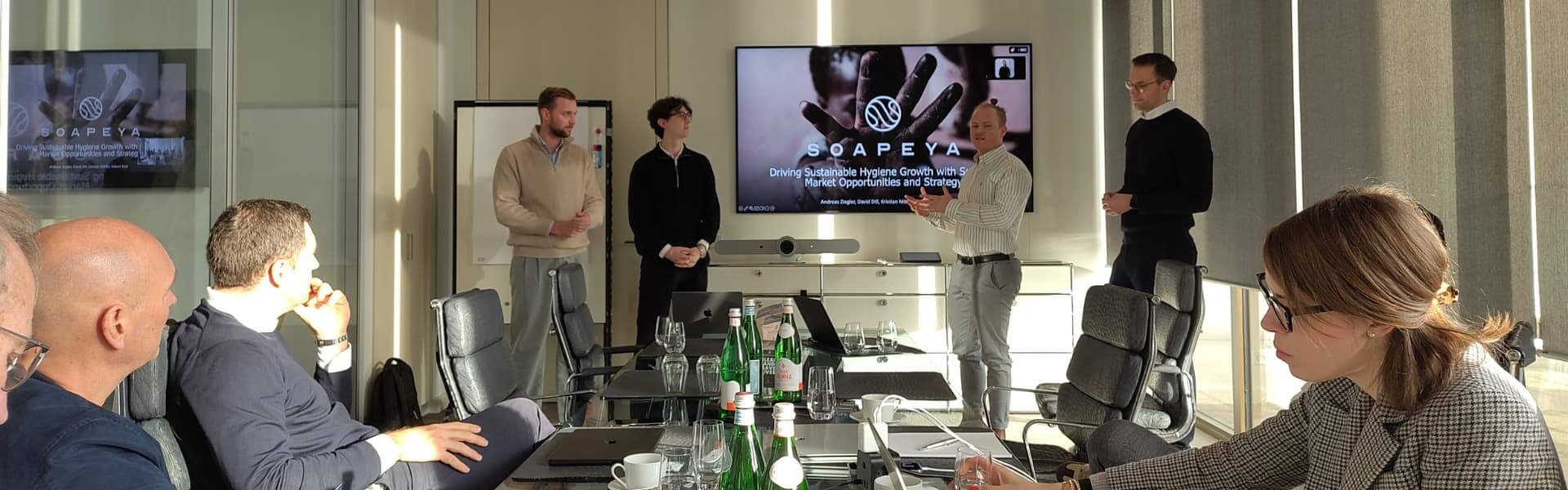
Another project team developed go-to-market strategies for Soapeya, a dry soap product initially designed for development aid contexts to provide access to hand hygiene in regions without clean water.
The team examined target groups, pricing strategies, communication channels, and market entry barriers.
The results included:
detailed market analyses
positioning strategies
concrete implementation roadmaps
Throughout the entire project, representatives of DN Group AG provided advisory support. Tim B. Nixdorff, Giulia Winden, and Dr. Peter Schneider contributed particularly actively with professional input and feedback.
During the final presentation,Boris Staab, Hanno Schädel, and Thomas Olek additionally joined the discussion with the students in the DN Group AG boardroom.
From Concept to Implementation: Final Presentation at DN Group AG in Frankfurt
After several months of intensive analysis and concept development, the eight teams presented their results at DN Group AG’s headquarters in Frankfurt. The final presentations took place directly in front of the board.
For the students, this represented a realistic pitch situation with immediate feedback from experienced decision-makers.
The company expressed strong appreciation for the professional quality and practical implementation potential of the concepts. DN Group AG explicitly welcomed the students’ input and announced plans for continued collaboration with CBS.
The project results were subsequently refined by the students for a workshop commissioned by DN Group AG. Such feedback highlights the strong practical relevance of the Business Projects. The developed concepts remain far from purely academic—they offer concrete implementation potential.
Exclusive Insight: Direct Exchange with the Board
A particular highlight was not only presenting the results but also discussing them directly with the DN Group board.
For the students, this provided:
valuable insights into strategic decision-making processes
honest, practice-oriented feedback
the opportunity to defend their arguments before experienced entrepreneurial leaders
The direct exchange demonstrated how academic knowledge and entrepreneurial practice interconnect. Especially in a part-time Master’s program, many participants benefit from combining their professional experience with rigorous academic analysis.
Conclusion: Learning from Real-World Example
The Business Project with DN Group AG exemplifies CBS’s structured commitment to practice-oriented learning. Corporate collaborations are not occasional add-ons but an integral part of the study programmes.
In our business programmes, the integration of real-world business practice is systematically embedded through:
Business Projects tackling real strategic and operational challenges from partner companies.
Regular Guest Lectures by senior executives and industry experts.
Conventions providing a platform for interdisciplinary learning and hands-on leadership experience.
Case Studies and Simulation Games designed to solve typical corporate problems.
Mandatory Internships to apply specialized skills within a corporate context.
Dual Study Formats ensuring continuous integration into corporate structures.
A Network of over 1,300 Partner Companies across a wide range of industries.
This structured integration enables students not only to analyze economic challenges but also to develop well-founded decisions under real market conditions.
With initiatives like this, CBS reinforces its commitment to closelylinking business and academia and preparingstudents specifically for leadership roles in a globalized and sustainability-oriented economy.
Key Takeaways
Study format: English-language, part-time Master’s programme at CBS.
Company: DN Group AG
Business project: 27 students developed real solutions in eight teams for DN Group AG in Frankfurt.
Focus topics: Impact investing, water credit markets and sustainable go-to-market strategies.
Academic supervision: Guided by Professor Dr Hanno Martens throughout the semester.
Board presentation: Results were presented directly to the board of DN Group AG.
Practical relevance: The project demonstrates the close integration of academic theory and corporate practice within the Master’s programme.
Practice-Oriented Learning: The Business Project in the Part-Time Master’s Programme
A core component of the part-time Master’s programmes at CBS is the Business Project. Conducted during the course of study, it combines academic methodology with real-world business challenges.
In the current project, students from the English-taught part-time Master’s programs in Strategic Management (M.Sc.)worked together in eight interdisciplinary teams. The project was led by Professor Dr. Hanno Martens, who provided academic guidance and coordinated collaboration with the corporate partner.
From September to December, the teams worked intensively on strategic and entrepreneurial challenges defined by DN Group AG in Frankfurt. The objective was to develop innovative yet implementable concepts that address current global trends such as sustainability, impact investing, and corporate responsibility.
analyze real company data
develop strategic recommendations
present their results to decision-makers
strategically expand their professional network
The Assignments: Impact Investing, Water Credit, and Market Entry Strategies
The project topics were developed in close coordination with DN Group AG. Students worked directly on strategically relevant issues for the company.
Impact Investing
Several teams analyzed the potential of impact investing strategies. The goal was to design investment models that generate both financial returns and measurable social or environmental impact.
The students:
examined market trends and regulatory frameworks
developed evaluation models for impact metrics
formulated concrete strategic recommendations for DN Group AG
Innovative Business Models for Save the Water GmbH
Another focus area was the development of new business models for Save the Water GmbH. The emphasis was on sustainable water solutions and their economic scalability.
The teams developed:
Business Model Canvas concepts
financing and partnership strategies
scenarios for international expansion
Water Credit Market
Within the Water Credit Market topic, students analyzed market structures and financing mechanisms in the field of water-related climate instruments.
The objective was to sharpen DN Group AG’s positioning in this growing market and identify strategic options for market entry or expansion.
Go-to-Market Strategies for Soapeya
Another project team developed go-to-market strategies for Soapeya, a dry soap product initially designed for development aid contexts to provide access to hand hygiene in regions without clean water.
The team examined target groups, pricing strategies, communication channels, and market entry barriers.
The results included:
detailed market analyses
positioning strategies
concrete implementation roadmaps
Throughout the entire project, representatives of DN Group AG provided advisory support. Tim B. Nixdorff, Giulia Winden, and Dr. Peter Schneider contributed particularly actively with professional input and feedback.
During the final presentation,Boris Staab, Hanno Schädel, and Thomas Olek additionally joined the discussion with the students in the DN Group AG boardroom.
From Concept to Implementation: Final Presentation at DN Group AG in Frankfurt
After several months of intensive analysis and concept development, the eight teams presented their results at DN Group AG’s headquarters in Frankfurt. The final presentations took place directly in front of the board.
For the students, this represented a realistic pitch situation with immediate feedback from experienced decision-makers.
The company expressed strong appreciation for the professional quality and practical implementation potential of the concepts. DN Group AG explicitly welcomed the students’ input and announced plans for continued collaboration with CBS.
The project results were subsequently refined by the students for a workshop commissioned by DN Group AG. Such feedback highlights the strong practical relevance of the Business Projects. The developed concepts remain far from purely academic—they offer concrete implementation potential.
Exclusive Insight: Direct Exchange with the Board
A particular highlight was not only presenting the results but also discussing them directly with the DN Group board.
For the students, this provided:
valuable insights into strategic decision-making processes
honest, practice-oriented feedback
the opportunity to defend their arguments before experienced entrepreneurial leaders
The direct exchange demonstrated how academic knowledge and entrepreneurial practice interconnect. Especially in a part-time Master’s program, many participants benefit from combining their professional experience with rigorous academic analysis.
Conclusion: Learning from Real-World Example
The Business Project with DN Group AG exemplifies CBS’s structured commitment to practice-oriented learning. Corporate collaborations are not occasional add-ons but an integral part of the study programmes.
In our business programmes, the integration of real-world business practice is systematically embedded through:
Business Projects tackling real strategic and operational challenges from partner companies.
Regular Guest Lectures by senior executives and industry experts.
Conventions providing a platform for interdisciplinary learning and hands-on leadership experience.
Case Studies and Simulation Games designed to solve typical corporate problems.
Mandatory Internships to apply specialized skills within a corporate context.
Dual Study Formats ensuring continuous integration into corporate structures.
A Network of over 1,300 Partner Companies across a wide range of industries.
This structured integration enables students not only to analyze economic challenges but also to develop well-founded decisions under real market conditions.
With initiatives like this, CBS reinforces its commitment to closelylinking business and academia and preparingstudents specifically for leadership roles in a globalized and sustainability-oriented economy.